


Search News
Global Industrial Intelligence Hub (GIIH)Industry Portal
Global Industrial Intelligence Hub (GIIH)Status
Standard Access
Upgrade to PremiumNewsHow Do Biotech Cold Chain Requirements Affect Shipping Costs?
Time
Click Count
How Do Biotech Cold Chain Requirements Affect Shipping Costs?
How do biotechnology cold chain requirements affect shipping costs? The short answer is that they turn transport from a basic freight purchase into a controlled risk-management process. A carton may travel by the same aircraft, truck, or courier network as other goods, but biologics, clinical materials, cell and gene therapies, reagents, and temperature-sensitive diagnostic products often require a very different level of preparation, oversight, and recovery planning.
The visible freight rate is only one part of the cost. The real budget may include qualified packaging, thermal testing or lane assessment, dry ice replenishment, temperature monitoring, specialist handling, customs documentation, insurance, priority transport, and contingency capacity. For high-value or irreplaceable material, the cost of a failed shipment can exceed the price of careful logistics by a wide margin. That is why biotech teams should evaluate cold-chain spend in terms of product protection and total exposure, not simply cost per kilogram.
Temperature Range Determines the Starting Cost
Not all cold-chain shipments are alike. A product that can remain stable within a refrigerated range presents a different logistics challenge from a frozen sample, an ultra-low-temperature material, or a shipment maintained in cryogenic vapor phase. The tighter the acceptable range, the less room there is for ordinary transit variation.
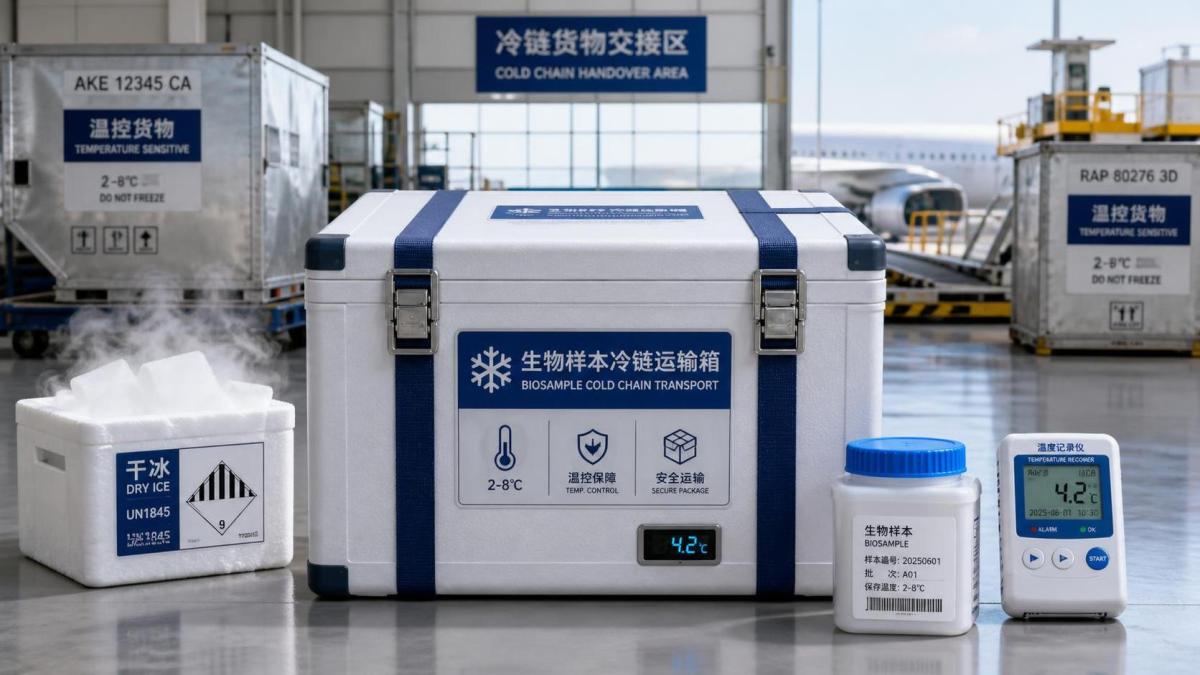
A typical refrigerated shipment may use insulated packaging with conditioned refrigerants and a temperature logger. Frozen consignments may require dry ice, while very low-temperature products can involve specialized passive or active systems designed around the product’s validated transport profile. Each step upward in thermal sensitivity can add material cost, handling requirements, weight, dimensional volume, and operational constraints.
The key distinction is not whether a package feels cold at dispatch. It is whether the selected system can maintain the required conditions for the complete journey: origin collection, warehouse dwell time, airport acceptance, flight connection, customs processing, final delivery, and possible delay. A package engineered only for nominal transit time may look economical until one missed connection consumes its thermal margin.
This is why shipment pricing often rises when a sponsor requests a wider duration capability than the scheduled route appears to need. The logistics provider is not only pricing travel time; it is pricing protection against the uncertainty surrounding travel time.
Packaging Is Both a Freight Cost and a Capacity Decision
Packaging is one of the most immediate cost drivers in biotechnology logistics. Qualified thermal shippers can be considerably more expensive than ordinary corrugated cartons, particularly when they are designed for demanding temperature bands or long international journeys. Reusable systems may reduce material waste over repeated lanes, but they require reverse logistics, cleaning, inspection, inventory control, and reliable return routes. A lower per-trip packaging cost is not automatically a lower program cost.
Size matters as much as insulation. Airfreight is commonly charged using actual weight or volumetric weight, depending on which is greater. Coolants, insulation panels, protective secondary packaging, and overpacks can make a relatively small vial shipment occupy far more billable space than its product weight suggests. For a low-volume, high-value biologic, this may be appropriate. For recurring shipments of less sensitive material, poor pack-out design can create avoidable spend.
Teams should therefore ask practical questions early: Can multiple units be consolidated without compromising stability? Is the qualified shipper oversized for the payload? Does a lane justify a reusable container? Can the product be released with a defined excursion-management process rather than an unnecessarily narrow operational target? These are quality and supply-chain questions together, not merely packaging questions.

Special Handling Creates Charges That Standard Freight Quotes May Not Show
Cold-chain freight is often quoted as a network of services rather than a single transport line. A shipment may need collection by a temperature-controlled vehicle, delivery into a designated handling area, priority build-up before departure, controlled storage during a connection, and a monitored final-mile handoff. Availability differs substantially by airport, carrier, destination, and time of year.
For shipments using dry ice, additional restrictions may apply because dry ice is regulated as a dangerous good for transport. The requirements and airline acceptance practices need to be checked for the specific shipment. That can introduce documentation, labeling, handling, and capacity considerations that do not arise with conventional parcels. It may also limit the practical choice of carriers or routings.
Direct flights are commonly preferred because every transfer adds exposure. Yet a direct service can cost more than an indirect route, and its schedule may not align with the consignee’s receiving hours. The cheapest itinerary is therefore not always the least expensive operational choice. If a package arrives on a weekend, sits pending clearance, or reaches a closed receiving site, lower line-haul freight can be erased by storage, intervention, or replacement costs.
Monitoring Adds Cost, but It Also Changes the Quality of the Decision
Temperature monitoring is often treated as a mandatory add-on, but its purpose should be more specific. A basic data logger can document whether conditions remained within a defined range. More advanced monitoring may transmit location, temperature, shock, light exposure, or other events during transit. The right choice depends on product risk, shipping lane maturity, investigation requirements, and the ability of people to act on alerts.
Real-time visibility is valuable only when there is an intervention path. An alert at 2 a.m. is of limited use if no party is authorized to contact the handler, arrange a dry ice top-up, redirect the shipment, or notify the consignee. Remote monitoring can increase equipment and service costs, but it may be justified on lanes where delays are common, product stability is limited, or chain-of-custody visibility is essential.
Data also has an economic role beyond a single shipment. Repeated temperature records can reveal whether a route, packaging configuration, or airport handoff is consistently robust. Without that evidence, organizations may keep paying for excessive insulation, premium routing, or broad thermal duration simply because no one has enough lane-level information to adjust the design responsibly.
Documentation and Border Delays Can Be More Expensive Than Transport
International biotech shipments must move through a documentation chain that may include commercial invoices, packing lists, import permits, export controls where applicable, certificates, dangerous-goods documentation, product descriptions, and consignee contact details. The exact requirements depend on the product, origin, destination, intended use, and local rules. Materials for research may be treated differently from commercial medicines, and human-derived or biological materials can introduce further requirements.
The shipping cost impact is not limited to broker fees. Incomplete descriptions, inconsistent values, missing permits, or an unavailable importer can interrupt clearance while a shipment’s thermal clock continues to run. Demurrage, storage, re-delivery, repacking, refrigerant replenishment, and product assessment may follow. In difficult situations, the shipment may need to be returned, destroyed, or replaced.
A strong pre-shipment review is usually cheaper than solving a border problem in real time. It should confirm not only that paperwork exists, but that the product name, tariff treatment, handling instructions, consignee details, and import responsibilities are understood by the relevant parties. This is especially important when research organizations, contract manufacturers, clinical sites, and distributors each assume someone else owns the clearance task.
Contingency Planning Is a Cost Driver—And a Necessary One
Biotech cold-chain logistics is priced around exceptions as well as planned movements. Weather disruption, aircraft changes, customs inspections, airport congestion, road closures, and failed delivery attempts can all challenge a temperature-controlled shipment. A credible plan identifies what happens if the consignment is delayed at each critical point.
That may mean arranging access to a qualified storage location, identifying an agent able to replenish dry ice, defining escalation contacts, confirming after-hours receiving capability, or selecting packaging with sufficient reserve duration. These preparations can carry direct fees or higher unit costs. However, a contingency plan should be proportionate. It makes little sense to build an elaborate intervention network for every low-risk domestic shipment, just as it is risky to use a bare-minimum design for a scarce clinical investigational product crossing several borders.
The most useful question is not, “How can we remove contingency cost?” It is, “Which failure modes would make this shipment unacceptable, and what is the least wasteful way to control them?”
Where Organizations Commonly Overspend
Over-specification is a recurring problem. Some organizations apply the same premium packaging, courier service, and monitoring model to every product and route because it appears safer. In reality, the correct design depends on stability data, shipment value, payload volume, frequency, route performance, and the consequences of loss. A mature domestic lane with reliable handoffs may not require the same controls as an inaugural shipment to a market with uncertain customs timing.
Fragmented ownership also increases cost. Quality teams may select packaging, procurement may negotiate freight, clinical operations may set delivery timing, and customs teams may manage paperwork separately. Each decision can be rational in isolation while the end-to-end shipment remains expensive or fragile. Integrated planning exposes trade-offs: a later collection may avoid weekend storage; a slightly larger shipper may prevent an emergency intervention; consolidation may save freight but create a greater loss concentration.
At GIIH, the intersection of health and medical technology with global logistics is viewed as an intelligence problem as much as a transport problem. Product requirements, route conditions, regulatory expectations, carrier capacity, and regional infrastructure rarely sit in one data source. Bringing those signals together helps decision-makers distinguish a necessary cold-chain investment from a habit that has never been re-examined.
A More Useful Way to Budget a Biotech Shipment
Instead of comparing only carrier quotes, build a shipment budget across six connected categories: packaging and refrigerants; transport and dimensional charges; specialized handling; monitoring and data review; customs and documentation; and exception readiness. Then evaluate each category against the product’s stability profile and the lane’s actual risk points.
Before approving a design, request clarity on the planned route, expected handoffs, packaging duration under the intended conditions, dry ice requirements if relevant, logger responsibilities, customs ownership, final delivery window, and escalation process. Where validation or qualification evidence is needed, it should be reviewed in the context of the actual shipment configuration rather than assumed from a generic packaging label.
Shipping costs rise because biotech cold-chain requirements demand control over conditions that conventional freight networks are not built to guarantee by default. The objective is not to buy the most expensive service. It is to match protection, visibility, and response capability to the product and lane—then revisit that match as volumes, regulations, and supply-chain conditions change. That disciplined approach turns logistics spending into a defensible operational decision rather than an emergency premium paid after risk has already surfaced.
Recommended News
 Sep 08, 2026Is Bio-Tech Enzyme Production Equipment Standardized Across Suppliers?Is Bio-Tech enzyme production equipment standardized across suppliers? Discover key standards, performance differences, and smart sourcing tips for reliable enzyme production.
 Sep 03, 2026How Do Biotech Cold Chain Requirements Affect Shipping Costs?How do biotechnology cold chain requirements affect shipping costs? Explore packaging, monitoring, customs, and contingency factors that shape smarter biotech logistics budgets.
 Aug 13, 2026Biotechnology Laboratory Research Insights for Faster Method SelectionBiotechnology laboratory research insights for faster method selection: learn how labs compare workflows, reduce validation risk, and choose scalable methods with more confidence.
 Aug 02, 2026How to Evaluate a Biotechnology Research Tracking Tool for Data Integrity and Team CollaborationBiotechnology research tracking tool evaluation starts with data integrity, audit trails, and collaboration risks. Learn what to test before you buy for faster, safer team decisions.
 Jul 12, 2026How to Evaluate a Biotech Alliance Intelligence Provider Before Market ExpansionBiotech alliance intelligence provider selection can define expansion success. Learn how to compare data quality, regional insight, and cross-sector signals before entering new markets.
 Jul 11, 2026Biotechnology Research Category Trends: Which Segments Are Attracting More Funding?Biotechnology research category trends reveal which biotech segments are winning funding, from therapeutics to AI platforms and synthetic biology. Explore the signals shaping smarter market moves.
 Jul 10, 2026Biotech Collaboration for Market Entry: Deal Structures, Risks, and Partner SelectionBiotech collaboration for market entry explained: compare deal structures, assess regulatory and IP risks, and choose the right partner to launch faster with greater control.
 Jul 08, 2026AI-Biotech Collaboration Analysis: Where Drug Discovery Teams Gain the Most Practical ValueAI biotech collaboration analysis reveals where drug discovery teams gain real value—better target selection, faster screening, and smarter lead optimization. Explore practical insights.
 Jul 05, 2026Biotechnology Research Vendor Selection: Key Criteria for Labs Comparing CROs and SuppliersBiotechnology research vendor selection starts with the right criteria. Learn how labs compare CROs and suppliers for quality, compliance, capacity, and cost to reduce risk and choose with confidence.
 Jun 24, 2026Biotech Collaboration Deal Volume: How to Read Partnering Activity and Market SignalsBiotech collaboration deal volume reveals where capital, pipeline demand, and regional strategy are shifting. Learn how to read partnering signals for smarter market insight.
 Jun 20, 2026Veterinary Supplies Purchasing Guide: How to Evaluate Quality, Shelf Life, and CostVeterinary supplies buying guide: learn how to evaluate quality, shelf life, compliance, and total cost to choose reliable suppliers, reduce waste, and make smarter purchasing decisions.
 Apr 16, 2026Biotech solutions with strong science can still face weak adoptionBiotech solutions can fail despite strong science when healthcare resources, usability, and trust lag. Explore lessons from IoT home security, water purifier, and climate technology to speed adoption.
 Apr 16, 2026Why biotech solutions fail to scale from lab to marketBiotech solutions often fail to scale when healthcare resources, compliance, and supply chains lag. Learn how climate technology, CO2 reduction, and sustainable solutions reach market faster.