


Search News
Global Industrial Intelligence Hub (GIIH)Industry Portal
Global Industrial Intelligence Hub (GIIH)Status
Standard Access
Upgrade to PremiumNewsPlastic Pallet Material Choices for Warehouses Focused on Cleaner Handling
Time
Click Count
Cleaner Handling Is Reshaping Warehouse Pallet Decisions
Material choice has become a more important part of warehouse pallet selection as distribution centers, food processors, pharmaceutical operators, electronics manufacturers, and export-focused facilities place greater emphasis on cleaner handling conditions. In many operations, pallets are no longer viewed as simple load carriers. They affect hygiene control, housekeeping effort, damage rates, worker handling consistency, and even how reliably goods move through automated systems. For technical evaluators, that makes pallet material a practical engineering and procurement question rather than a routine purchasing line item.
Cleaner handling usually refers to more than visible tidiness. It can include reducing dust generation, limiting moisture absorption, improving washability, lowering contamination transfer risk, and supporting better control over damaged surfaces, splinters, or residue. Warehouses that handle packaged food, personal care products, medical supplies, chemicals, and sensitive components often face closer internal quality requirements even when formal regulations differ by sector. Under those conditions, the material behind a pallet’s structure influences daily performance in ways that become noticeable over time.
Plastic options often enter the discussion when procurement teams are trying to align handling cleanliness with durability and process stability. The key issue is not whether one material is universally superior. It is whether a given material fits the operating environment, cleaning routine, load profile, storage method, and total replacement cycle of the warehouse. That is where technical assessment matters most.
Why Material Selection Matters More in Cleaner Operations
In conventional warehousing, a pallet may be judged mainly by basic strength, unit price, and availability. In cleaner handling environments, the list becomes longer. Surface condition, porosity, water resistance, ease of sanitation, impact behavior, and consistency across repeated use all become part of the evaluation. A pallet that performs adequately in a rough outbound staging area may create avoidable cleaning and inspection burdens in a facility where dust, residue, or moisture control is monitored more closely.
Wood has long been accepted because it is widely available and familiar. Even so, some operators reconsider it when they experience splintering, nail exposure, moisture retention, or fragmented debris in picking and packing zones. Corrugated paper and metal pallets also serve important roles in some supply chains, but they are usually selected for very specific transport, export, or heavy-duty conditions. Plastic becomes relevant when a warehouse wants a more uniform and washable platform that may better support controlled environments.
This is also a workflow issue. Cleaner handling standards often increase the cost of interruptions. If pallets need frequent sorting due to damage, absorb spills, or shed particles that complicate housekeeping, labor efficiency drops. The material choice therefore affects not only hygiene perception but also operational rhythm, inspection frequency, and inventory reliability.

The Main Plastic Material Paths Procurement Teams Compare
When technical teams review plastic pallets, they are usually not evaluating a single uniform category. The term covers different resin choices and manufacturing approaches, each with tradeoffs. High-density polyethylene is commonly considered for its balance of impact resistance, moisture resistance, and suitability for repeated handling. Polypropylene may be assessed where stiffness, dimensional stability, or particular process requirements are relevant. Recycled resin and virgin resin options can also lead to different expectations around consistency, appearance, and long-term durability.
The manufacturing method matters alongside the base material. Injection-molded designs may offer tighter dimensional consistency and smoother surfaces, which can be useful in facilities with automation or stricter cleaning protocols. Blow-molded and thermoformed variants may be considered in other contexts depending on cost targets, weight limits, and distribution patterns. For procurement teams, material cannot be separated from structural design, because a strong resin choice can still underperform if the pallet geometry does not match the load or racking condition.
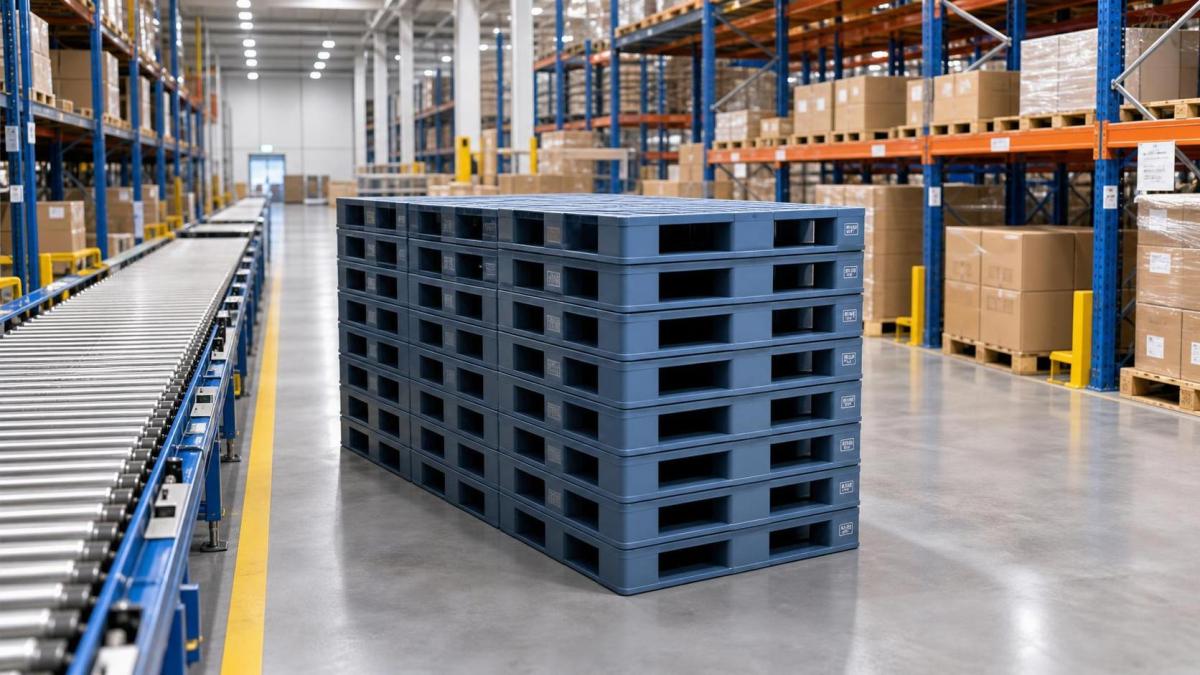
For warehouses comparing lifecycle performance, Plastic Pallet is often evaluated through a combination of material composition, deck construction, static and dynamic load behavior, washdown compatibility, repair policy, and expected service life under real handling conditions.
Key Evaluation Criteria for Cleaner Handling Warehouses
A cleaner handling objective usually leads evaluators toward a more structured checklist. The first area is surface hygiene performance. Smooth, non-absorbent surfaces may be easier to clean and less likely to retain moisture or residue. This can matter in facilities where spills, frequent washdowns, or dust-sensitive products are part of normal operations. Open deck and closed deck designs may also behave differently during cleaning, drainage, and debris accumulation.
The second area is damage behavior. Every pallet material degrades differently. Technical buyers should look beyond whether damage occurs and instead ask how it appears, how quickly it can be detected, whether it creates contamination concerns, and whether the pallet remains safe for forklifts, pallet jacks, conveyors, or rack storage. Cracks, edge wear, and localized deformation may be more operationally significant than cosmetic marks.
Third is load environment compatibility. A warehouse focused on cleaner handling still has to move real product loads. Static capacity, dynamic capacity, and racking capacity need to be matched against the actual use case rather than assumed from generic specifications. Stretch-wrapped consumer goods, bagged ingredients, liquid containers, and cartonized medical products can place very different stresses on a pallet deck.
Fourth is environmental exposure. Temperature swings, cold storage, direct sunlight in staging zones, chemical contact, and repeated washing may all influence which material grade is suitable. A pallet that performs well in an ambient warehouse may not behave the same way in chilled distribution or in operations that regularly sanitize equipment and handling assets.
Common Buying Mistakes That Create Downstream Risk
One common mistake is treating all plastic pallets as interchangeable. Procurement teams sometimes move too quickly from the general category to price comparison, without confirming the resin type, reinforcement approach, underside structure, and intended handling cycle. That can result in units that look suitable on paper but fail earlier in edge cases such as rack loading, cold environments, or repeated turning by automated equipment.
Another mistake is focusing only on cleaning convenience while underestimating mechanical demands. Cleaner handling is valuable, but it does not replace the need for stable fork entry, resistance to impact, and acceptable performance under stacked loads. If sanitation performance is prioritized without structural fit, the warehouse may simply exchange one type of operating problem for another.
A third issue is failing to define end-of-life criteria. Technical teams should know what level of cracking, warping, or deck wear triggers removal from service. Cleaner facilities benefit from a more disciplined rejection standard because borderline pallets can create uncertainty in inspection and housekeeping. This is especially important in shared pools or multi-site operations where condition control varies.
How Different Warehouse Scenarios Change the Best Choice
Not every cleaner handling warehouse needs the same pallet material strategy. In food and beverage distribution, washability and moisture resistance may carry greater weight, especially where secondary packaging can leak or where cleaning routines are frequent. In pharmaceutical and healthcare supply chains, operators may place more value on consistency, traceability practices, and lower particle risk in controlled storage areas. Electronics and precision component warehouses may focus on cleanliness, dimensional reliability, and smooth movement through internal material flow systems.
Export-oriented operations may weigh another factor: whether the pallet choice simplifies cross-border movement and reduces treatment-related concerns associated with other materials. Meanwhile, highly automated warehouses may give top priority to dimensional uniformity, stable underside design, and predictable interaction with conveyors, stackers, and shuttle systems. In these settings, a technically clean solution that performs inconsistently in automation can still become a costly mismatch.
For mixed-use facilities, standardization can be more useful than selecting the most specialized option. A slightly more conservative material and design choice may support cleaner handling while reducing confusion across departments. Procurement teams often benefit from mapping pallet categories to distinct workflows rather than letting multiple incompatible formats accumulate over time.
A Practical Framework for Technical Evaluation
A sound buying process usually begins with operational observation rather than specification sheets alone. Evaluators should document where the pallet will travel, what it will carry, how often it will be cleaned, how it will be stored, and what types of damage are already causing loss or disruption. That baseline helps convert a broad material discussion into measurable decision criteria.
From there, a shortlist can be tested against several questions:
- Does the pallet surface support the facility’s actual cleaning routine?
- Will the material remain stable under expected temperature and moisture conditions?
- Does the structure fit forklifts, pallet jacks, racks, and automation interfaces already in use?
- How visible and manageable is damage over time?
- Is the cost model based on one-way use, closed-loop reuse, or a shared operational pool?
Short pilot programs are often more informative than broad assumptions. Even a limited trial can reveal whether pallets retain water after cleaning, drag debris into storage lanes, flex too much under certain loads, or create unexpected handling friction. For technical evaluators, this step often separates marketing claims from operational fit.
What the Decision Means for Procurement and Operations
The material decision influences more than the pallet budget. It can affect labor used for cleaning and sorting, product damage exposure, housekeeping standards, maintenance planning, and internal quality audits. In some warehouses, the operational savings from a more suitable pallet material may come from fewer disruptions rather than from direct unit cost reduction. That is why technical teams, procurement managers, and warehouse operators should align their evaluation criteria early.
Cleaner handling is not achieved through pallet material alone, but pallet selection can support or weaken broader process goals. Warehouses that treat the decision as part of system design rather than isolated purchasing are usually better positioned to balance hygiene expectations, mechanical performance, and long-term operating cost. For facilities under pressure to reduce contamination risk while maintaining throughput, careful material selection remains a practical place to start.
Recommended News
 Aug 14, 2026How to Choose Pallet Systems for Warehouse Throughput and Space EfficiencyPallet systems can transform warehouse throughput and space efficiency. Discover how to choose the right solution for your operation and boost performance.
 Aug 04, 2026How to Compare Secure Warehousing Solutions for High-Value InventorySecure warehousing solutions for high-value inventory: learn how to compare layered security, traceability, exception control, and resilience to reduce loss and choose the right provider.
 Jul 31, 2026How to Evaluate Warehousing Solutions for Faster Throughput and Lower Operating CostsWarehousing solutions should be judged by throughput, labor reality, and integration—not storage alone. Learn how to cut delays, lower operating costs, and choose a faster, more resilient warehouse model.
 Jul 28, 2026Plastic Pallet Material Choices for Warehouses Focused on Cleaner HandlingPlastic Pallet material choices can improve cleaner handling, washability, and workflow stability in warehouses. Explore how to compare resin, design, and lifecycle fit for smarter procurement.
 Jul 14, 2026Inventory Tracking for Warehouse Operations: Systems, Accuracy Metrics, and Workflow FitInventory tracking warehouse success starts with the right system, clear accuracy metrics, and workflow fit. Learn how to reduce errors, speed operations, and improve stock visibility.
 Jul 11, 2026Smart Storage Solutions for Fast-Moving Inventory: Which Setup Fits Your Warehouse?Smart storage solutions for fast-moving inventory: discover how to match warehouse flow, SKU volatility, and space limits with the right setup to boost speed, accuracy, and resilience.
 Jul 08, 2026Inventory Management Solutions: Which Features Matter Most for Multi-Site Warehousing?Inventory management solutions for multi-site warehousing: discover the features that improve real-time visibility, stock accuracy, transfers, and faster order fulfillment.
![]() Jul 07, 2026What Does Order Fulfillment Include? Key Steps, Costs, and KPIs for Growing OperationsOrder fulfillment includes far more than shipping—learn the key steps, main cost drivers, and KPIs that help growing operations improve accuracy, speed, and customer experience.
Jul 07, 2026What Does Order Fulfillment Include? Key Steps, Costs, and KPIs for Growing OperationsOrder fulfillment includes far more than shipping—learn the key steps, main cost drivers, and KPIs that help growing operations improve accuracy, speed, and customer experience. Jul 03, 2026Warehouse Management Solutions for Fulfillment Centers: Features That Improve Picking AccuracyWarehouse management solutions for fulfillment centers improve picking accuracy with real-time inventory, scan verification, and guided workflows—discover features that cut errors and boost speed.
 Jun 26, 2026How to Choose Order Fulfillment Services for DTC, B2B, and Marketplace OrdersOrder fulfillment services for DTC, B2B, and marketplace orders: learn how to compare providers, reduce hidden costs, improve delivery performance, and choose a scalable partner with confidence.
 Jun 24, 2026How to Find the Right Solution Fit by Load Capacity for Storage and Material HandlingSolution fit by load capacity starts with real load data. Learn how to choose safer, more efficient storage and material handling systems that reduce risk and support growth.
 Jun 12, 2026How to Choose Refrigeration Equipment for Cold Storage: Key Specs and System TypesRefrigeration equipment selection for cold storage starts with the right specs and system type. Learn how to compare capacity, efficiency, refrigerants, and lifecycle cost.
 Jun 03, 2026Smart Manufacturing Trends 2026 for Warehouse Automation: Robotics, WMS, and ROISmart manufacturing trends 2026 for warehouse automation reveal how robotics, modern WMS, and ROI-focused strategies boost efficiency, resilience, and scalable growth.
 May 29, 2026When does animal feed quality decline in storage?Animal feed quality can decline before visible spoilage. Learn key storage risks, early warning signs, and practical steps to protect nutrition, safety, and value.
 May 16, 2026What warehouse automation trends matter most in 2026?Smart manufacturing trends 2026 for warehouse automation: discover the key 2026 shifts in AI orchestration, scalable robotics, and real-time visibility to boost resilience, accuracy, and ROI.
 May 07, 2026Inventory control breaks down when demand looks stableInventory control can fail even when demand looks stable. Discover how procurement, logistics management, and supply chain risks affect aftermarket, industrial parts, and EV components.
 May 06, 2026The slow-moving stock problem in inventory controlInventory control for aftermarket, auto parts, EV components, and industrial parts: learn how procurement and supply chain teams cut slow-moving stock, improve logistics management, and protect cash flow.
 May 06, 2026Why inventory control misses hidden carrying costsInventory control often hides carrying costs across procurement, logistics management, and the supply chain. Discover smarter sourcing for auto parts, EV components, and precision engineering.
 May 04, 2026Inventory control works differently for low-volume partsInventory control for aftermarket and industrial parts works differently for low-volume precision parts, custom components, and EV components. Learn smarter procurement and supply chain strategies.
 May 02, 2026Car spare parts profits often disappear in fulfillmentCar spare parts profits often vanish in fulfillment. Learn how procurement, inventory control, logistics management, and supply chain strategy protect margins in aftermarket and auto parts operations.
 May 02, 2026Inventory control mistakes usually start with bad item dataInventory control issues often begin with bad item data. Learn how procurement, logistics management, and supply chain teams handling auto parts, aftermarket, industrial parts, and EV components can reduce costly errors.
 Apr 27, 2026Which replacement parts are worth stocking in advance?Replacement parts worth stocking first: learn how smart inventory, vehicle upgrades, car accessories trends, recycling solutions, and sustainable technology reduce downtime and costs.