


Search News
Global Industrial Intelligence Hub (GIIH)Industry Portal
Global Industrial Intelligence Hub (GIIH)Status
Standard Access
Upgrade to PremiumNewsWhat problems can automation solutions solve first?
Time
Click Count
For business decision-makers, the first question is not whether to automate, but where automation delivers value fastest.
Industrial & Manufacturing automation solutions usually solve urgent issues first: labor pressure, uneven quality, process delays, and poor operational visibility.
The best starting point is rarely the most advanced project.
It is the process where waste is highest, variation is frequent, and returns can be measured within a practical timeline.
Across sectors tracked by GIIH, early automation wins often come from repetitive workflows, inspection tasks, material movement, and production planning.
This article answers the most searched questions about what problems Industrial & Manufacturing automation solutions should solve first.
What problems can Industrial & Manufacturing automation solutions solve first?
The first problems are usually repetitive, measurable, and costly.
Industrial & Manufacturing automation solutions create the fastest value when they target known bottlenecks instead of broad transformation goals.
In most operations, five issues rise to the top:
- High labor dependence in repetitive tasks
- Inconsistent product quality
- Production bottlenecks and downtime
- Slow material handling and internal logistics
- Limited real-time data for decisions
These are common in electronics, packaging, medical devices, automotive parts, warehousing, and smart home equipment production.
They also appear in mixed environments where manual work and digital systems are only partly connected.
When Industrial & Manufacturing automation solutions address these issues first, results are easier to track through cycle time, scrap rate, throughput, and labor utilization.
Why do labor-intensive and repetitive tasks come first?
Because they combine cost pressure with predictable process rules.
Tasks like pick-and-place, screwdriving, labeling, sorting, sealing, and palletizing are ideal starting points for Industrial & Manufacturing automation solutions.
These tasks are frequent, standardized, and often affected by fatigue, staffing gaps, or safety concerns.
Automation reduces manual strain while improving speed consistency across shifts.
It also helps stabilize output when labor availability changes.
In many factories and distribution sites, this is the fastest route to visible ROI.
Typical early-win examples
- Automated packing lines for uniform products
- Robotic palletizing at end-of-line stations
- Conveyor-based part transfer between work cells
- Barcode or RFID-driven sorting workflows
These applications do not require a full plant redesign.
They often integrate with existing equipment, making Industrial & Manufacturing automation solutions easier to approve and implement.
Can automation improve quality before it transforms the whole operation?
Yes, and quality control is often one of the smartest starting points.
Industrial & Manufacturing automation solutions can improve quality by standardizing process steps and detecting defects earlier.
Machine vision, sensor-based checks, and automated measurement systems reduce dependence on subjective inspection.
This matters where tolerances are tight or traceability is important.
Examples include medical components, precision automotive parts, consumer electronics, and sustainability equipment assemblies.
What quality problems are solved first?
- Missed defects during visual inspection
- Variation in torque, fill level, or placement
- Late detection that increases rework costs
- Poor traceability across batches or stations
Quality-focused Industrial & Manufacturing automation solutions often produce benefits beyond scrap reduction.
They support compliance, customer confidence, and more reliable root-cause analysis.
That makes them valuable in both high-volume and high-mix production settings.
How do Industrial & Manufacturing automation solutions remove bottlenecks?
A bottleneck is the point where work accumulates and overall output slows.
Industrial & Manufacturing automation solutions remove bottlenecks by balancing flow, reducing idle time, and synchronizing connected steps.
The key is to automate the constraint, not just any available task.
If one station limits throughput, upgrading another area may produce little benefit.
That is why process mapping should happen before equipment selection.
Common bottleneck signals
- Frequent queue buildup before one machine
- High overtime despite stable demand
- Manual handoffs causing waiting time
- Downtime from inconsistent material supply
Examples include automated feeders, buffer systems, integrated conveyors, and scheduling tools linked to real-time production data.
In logistics-heavy operations, Industrial & Manufacturing automation solutions also reduce delays in picking, staging, and dispatch preparation.
What visibility gaps should automation solve before advanced AI projects?
Many operations still run with delayed reporting or disconnected spreadsheets.
Before advanced analytics, Industrial & Manufacturing automation solutions should first create accurate, timely, and usable operational data.
Without that foundation, AI models and forecasting tools are built on weak inputs.
Basic visibility can deliver immediate value.
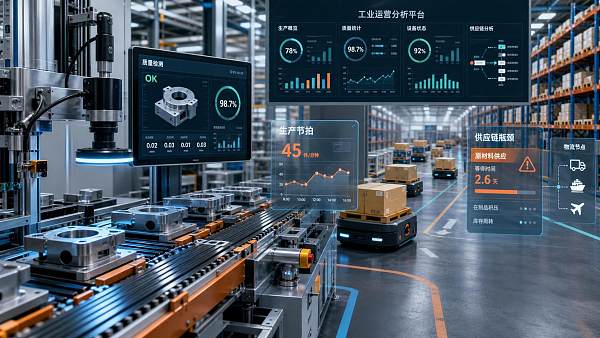
Sensors, PLC integration, MES connections, and dashboard reporting help teams see downtime reasons, output trends, energy use, and defect sources.
Priority data points to capture first
- Cycle time by station
- Downtime frequency and duration
- Scrap and rework rates
- Material movement and inventory location
- Energy consumption at critical assets
Industrial & Manufacturing automation solutions become more effective when decision-making is based on real operating signals instead of assumptions.
How should companies decide where to start and what to avoid?
Start with value, not technology excitement.
The best entry point for Industrial & Manufacturing automation solutions usually has four characteristics: high repetition, measurable loss, stable process steps, and realistic integration effort.
A pilot should be small enough to control, yet important enough to prove business value.
Selection checklist
- Is the problem frequent and costly?
- Can performance be measured clearly?
- Is the process stable enough to automate?
- Will the solution integrate with current systems?
- Are training and maintenance requirements realistic?
Mistakes to avoid
- Automating a broken process without redesign
- Choosing oversized systems for simple needs
- Ignoring data readiness and change management
- Expecting instant ROI from complex transformations
In cross-industry practice, Industrial & Manufacturing automation solutions succeed faster when deployment is phased, measurable, and linked to one operational objective at a time.
FAQ table: which automation problem should be solved first?
The first value from Industrial & Manufacturing automation solutions usually comes from solving visible operational pain, not chasing full digital maturity at once.
Start where losses are repetitive, measurable, and linked to business performance.
That may be labor-heavy packaging, inspection instability, a constrained station, or missing production visibility.
Each successful step creates data, confidence, and internal alignment for the next phase.
For organizations evaluating Industrial & Manufacturing automation solutions, the practical next move is simple: map losses, rank use cases, and launch one high-impact pilot with clear metrics.
That is how automation begins solving the right problems first.
Recommended News
 Sep 28, 2026What does compliance requirement analysis cost by project scope?Compliance requirement analysis cost comparison by project scope: compare small, mid-scale, and enterprise assessments, key cost drivers, ROI, and smarter budget controls.
 Sep 19, 2026When project planning support prevents costly delays in complex projectsProject planning support helps complex teams expose critical dependencies, protect schedule float, and prevent costly delays before risks become irreversible problems.
 Sep 18, 2026How to size industrial compressors for fluctuating air demandIndustrial compressors for fluctuating air demand: learn how to size capacity, storage, controls, and pressure recovery for reliable, energy-efficient performance.
 Sep 14, 2026How a material selection analysis guide reduces failure riskMaterial selection analysis guide: reduce failure risk with practical steps for performance, manufacturing, compliance, and supply-chain decisions.
 Sep 13, 2026What drives procurement research platform cost for enterprise teams?Procurement research platform cost explained: assess data quality, coverage, licensing, hidden costs, and ROI to make confident enterprise sourcing decisions.
 Sep 11, 2026How an industrial market analysis framework supports investment decisionsIndustrial market analysis framework: turn demand, competition, supply-chain risk, and regulation into smarter, resilient investment decisions.
 Sep 07, 2026What to look for in a material selection analysis providerDiscover how to choose a material selection analysis provider with proven engineering expertise, traceable data, validation capabilities, compliance insight, and supply-chain intelligence.
 Sep 03, 2026When do mobility control components need redundant safety features?Mobility control components need redundant safety features when one failure could cause hazardous motion. Learn how to build independent, testable protection.
 Sep 02, 2026How to use an industrial market analysis database for market sizingLearn how an industrial market analysis database supports accurate market sizing through clear boundaries, data triangulation, classification mapping, and actionable insights.
 Sep 01, 2026How a performance factor analysis platform reveals operational bottlenecksPerformance factor analysis platform insights help teams uncover hidden operational bottlenecks, validate root causes, and improve throughput across complex operations.
 Sep 19, 2026Is modular systems furniture practical for growing offices?Modular systems furniture for offices helps growing teams scale efficiently. Explore costs, flexibility, privacy, and implementation tips for smarter workspace decisions.
 Sep 17, 2026How to size a modular systems furniture workstation for daily useModular systems furniture workstation sizing guide: optimize desk space, ergonomics, circulation, power capacity, and flexibility for productive daily use.
 Sep 16, 2026How much storage can modular systems furniture add to a workspace?Modular systems furniture storage can unlock usable workspace capacity. Explore smart layouts, flexible modules, and practical planning tips for efficient, scalable organization.
 Sep 15, 2026When does modular systems furniture customization justify its cost?Modular systems furniture customization: learn when flexibility, lifecycle savings, and scalable workplace design justify the investment.
 Sep 14, 2026What should installation plans cover for modular systems furniture?Modular systems furniture installation plans should cover scope, site verification, logistics, safety, power coordination, quality checks, and handover for a seamless workspace launch.
 Sep 13, 2026What drives modular systems furniture price in office projects?Modular systems furniture price explained: uncover layout, materials, power, installation, and lifecycle factors to budget smarter and build adaptable offices.
 Sep 12, 2026How to verify sustainable materials in modular systems furnitureModular systems furniture sustainable materials: learn how to verify sourcing, emissions, certifications, and repairability with a practical supplier checklist.
 Aug 29, 2026Which pricing trends matter most when comparing product categories?Pricing trends reveal more than unit costs. Learn how to compare categories by cost drivers, lifecycle value, regional gaps, technology shifts, and discounts.
 Aug 28, 2026When does energy-efficient design reduce lifetime operating costs?Energy-efficient design can cut lifetime operating costs when real savings outweigh capital, maintenance, and reliability risks. Learn how to assess TCO, tariffs, utilization, and payback.
 Aug 27, 2026When does wholesale structural steel make sense for a project?Structural steel beams wholesale can reduce total project risk when demand is stable. Discover how to balance cost, quality, phased delivery, and traceability.
 Sep 03, 2026How Operating Pressure in PSI Affects Poultry Nipple Drinker PerformancePoultry nipple drinker operating pressure PSI manufacturer guide: optimize flow, prevent leaks, and ensure reliable water delivery across every line.
 Aug 22, 2026When weighted performance factor analysis improves vendor selectionWeighted performance factor analysis improves vendor selection when quality, compliance, delivery, and lifecycle risk matter more than price alone. Learn when this method creates smarter, defensible sourcing decisions.
 Aug 16, 2026How to verify hotel automation PCB assembly specs before supplier approvalHotel automation PCB assembly specs should be verified before supplier approval by checking DFM, testing, traceability, and compliance—learn the key steps to avoid field failures.
 Aug 15, 2026How does market trend analysis affect price expectations?Market trend analysis price insights help you set smarter expectations, spot real price shifts, and make faster, more confident pricing decisions.