


Search News
Global Industrial Intelligence Hub (GIIH)Industry Portal
Global Industrial Intelligence Hub (GIIH)Status
Standard Access
Upgrade to PremiumNewsWhen do mobility control components need redundant safety features?
Time
Click Count
Redundant safety features are warranted when a single failure in a mobility system could create an unacceptable risk of injury, loss of control, uncontrolled motion, collision, dropped load, or delayed emergency response. The decision should not be based on whether a component appears robust under normal operation. It should be based on what happens when it does not operate as intended.
For mobility control components such as brakes, steering actuators, position sensors, drive controllers, limit switches, emergency-stop circuits, interlocks, and load-holding mechanisms, redundancy is usually justified when there is no safe manual recovery, no practical warning time, or no independent physical barrier between motion and people.
A second safety path does not simply mean buying two identical parts. Effective redundancy requires independence: the backup must still function when the primary component, its power supply, wiring, software signal, mounting, or environmental protection has failed.
Start with the consequence of a single failure
The most useful selection question is: Can one reasonably foreseeable fault lead directly to hazardous movement? If the answer is yes, a single-channel design is rarely enough.
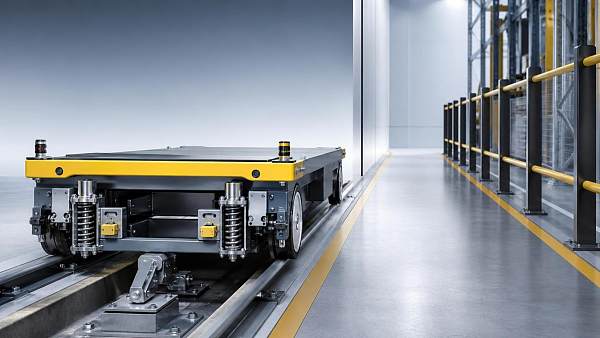
Consider a powered trolley that travels in a restricted aisle. A drive-controller failure may cause unexpected acceleration, while a sensor failure may prevent slowing at the end of travel. If an operator can be struck before recognizing the problem, an independent braking path, separate end-of-travel protection, or a mechanical stop may be necessary.
The same logic applies to mobile platforms, lift mechanisms, automated gates, industrial doors, vehicle subassemblies, powered medical mobility devices, and warehouse equipment. The component type is less important than the failure consequence. A low-cost caster lock may not need redundant control in a low-risk storage cart. A similar lock on a mobile work platform near personnel may need a second restraint or a brake-status verification system.
A practical distinction is between a failure that creates inconvenience and one that creates exposure. A system that stops and waits for repair may interrupt production but remain safe. A system that can continue moving, roll away, fall, steer incorrectly, or restart unexpectedly has a different design requirement.
Conditions that usually justify redundant safety features
Redundancy becomes more compelling when several risk factors exist at the same time. One factor alone may be manageable through sound design and inspection. Combined factors can make a single protective device difficult to defend.
- People share the motion zone. Pedestrian access, manual loading, maintenance activity, or public-facing use increases the consequence of control failure.
- The equipment carries, lifts, or restrains a load. Gravity, inertia, stored energy, and shifting loads can continue to act after power is removed.
- The system has meaningful speed or travel distance. A modest fault becomes more serious when stopping distance is long or there is little room to recover.
- Loss of control can occur without warning. Sudden steering, braking, or drive faults leave little opportunity for users to react.
- The operating environment degrades reliability. Water, washdown, vibration, dust, corrosion, temperature variation, cable flexing, and electromagnetic interference can affect sensors, connectors, and actuators.
- Access for maintenance is limited or inspections are infrequent. A latent fault can remain unnoticed until another failure occurs.
- The application must remain controllable during a fault. Stopping may not be the safest response for equipment on a slope, carrying a suspended load, or operating in a traffic path.
Redundancy should also be considered when the same control channel is relied on for both normal function and emergency protection. For example, using the main software command to stop a drive may be appropriate for ordinary deceleration, but it should not be the only means of preventing hazardous motion when the controller, communications link, or logic itself could fail.
Not all redundancy provides real protection
Two devices connected to the same supply, routed through the same connector, mounted on the same vulnerable bracket, and interpreted by the same controller may look redundant on a parts list. In practice, they can fail together.
This is the common-cause failure problem. It is one of the main reasons redundant mobility control components underperform in real use. A duplicated wheel-speed sensor offers limited protection if both sensors are exposed to the same debris buildup. Dual brake commands do not create an independent safety function if both depend on the same software output. Two mechanical restraints may be ineffective if both are released by one damaged linkage.
When reviewing a proposed design, trace each safety path from hazard detection to safe state. Ask whether the paths share any of the following:
- Power source, fuse, ground, or power converter
- Sensor mounting point or mechanical transmission
- Connector, cable route, communication bus, or enclosure entry
- Controller, firmware, input module, or logic decision
- Actuator, release mechanism, or hydraulic or pneumatic source
- Maintenance activity, adjustment procedure, or inspection method
Shared elements are not automatically unacceptable. They need to be understood and controlled. A mechanical spring-applied brake, for instance, may provide a genuinely different failure response from an electrically commanded drive stop. If power is lost, the drive may no longer propel the system while the brake moves toward engagement. That separation is often more meaningful than adding a second electronic command to the same drive circuit.
Choose the safe state before choosing the components
Redundancy is only useful when the system has a defined safe state. For many mobility applications, that state is stopped, braked, isolated from drive power, and prevented from unintended restart. Yet “stop” is not always sufficient.
A mobile unit on an incline may need to stop and hold position. A vertical mechanism may need controlled descent or load holding rather than an abrupt release. An articulated device may need to stop while preserving stability. A powered door may need to stop and reverse if closing motion could trap a person. The required protective functions should be stated in operational terms before comparing components.
The important word is “independent.” A physical stop may protect against a control-system error. A monitored brake may protect against failed braking force. A second sensor with a different sensing principle may reveal a false but believable primary signal. The right backup depends on the failure mechanism, not on a generic preference for duplication.
Separate fault detection from fault tolerance
Some systems only need to detect a fault early and enter a safe stop. Others must continue to provide controlled mobility after one fault. These are different requirements.
For equipment used intermittently in a guarded space, a detected fault followed by shutdown may be adequate. A brake feedback switch, current monitoring, or sensor plausibility check can reveal that the commanded state was not achieved. The system can then inhibit movement until the defect is corrected.
For equipment operating on public routes, supporting a person, carrying unstable loads, or working where stopping itself creates a hazard, fault tolerance may be needed. In that case, the backup feature must not only detect a fault; it must maintain or restore safe control. Examples include dual-circuit braking, redundant steering-position feedback, load-holding valves, separate emergency steering capability, or independent emergency power for a controlled stop.
Confusing detection with tolerance creates a frequent selection error. A dashboard alarm is not a safety function if the hazard develops faster than a person can act. Likewise, a controller diagnostic does not replace an independent protective channel when the controller is part of the fault scenario being considered.
Where redundancy is often under-specified
Brake selection receives attention because braking is visible and easy to understand. Less obvious weaknesses often sit upstream. A brake may be capable of holding the load, but the release signal may be vulnerable to a stuck relay, damaged cable, or incorrect logic state. A position sensor may be rated for the environment, but its bracket may loosen under vibration and create a repeatable yet inaccurate reading. A limit switch may work during commissioning but become inaccessible for functional testing after installation.
Power architecture also deserves scrutiny. When a control system loses supply voltage, does it move toward a safe condition, remain in its last state, or release a restraint? The answer should be explicit for each mobility control component. “Fail-safe” is not a useful label unless the actual failure mode is known. A spring-applied brake can be fail-engaged for electrical power loss, but its performance still depends on correct mechanical adjustment, friction condition, and the ability to release and engage reliably.
Environmental effects should be reviewed as part of the redundancy decision, not after component selection. Moisture may bridge connectors; fine dust can obstruct mechanisms; washdown can degrade seals; repeated flexing can damage conductors inside an apparently intact cable. In such conditions, redundancy should be paired with protected routing, suitable housings, strain relief, inspection access, and diagnostic checks. Adding a second unprotected component often doubles maintenance burden without solving the underlying exposure.
A practical evaluation sequence
Selection becomes clearer when the review follows the motion path rather than a catalog of components.
- Define the hazardous motion. Identify the direction, speed range, load condition, accessible areas, stopping distance, and what happens after loss of power or control.
- List credible single faults. Include broken wires, stuck outputs, sensor drift, disconnected feedback, seized mechanisms, loss of communications, misadjustment, and environmental contamination.
- Determine the required safe state. State whether the equipment must stop, hold, reverse, descend in a controlled way, isolate power, or prevent restart.
- Check whether one fault defeats both command and protection. This exposes common-cause failures and false redundancy.
- Select independent protective measures. Combine electrical, mechanical, hydraulic, pneumatic, or software-based measures where each addresses a different fault path.
- Plan proof testing and maintenance. A redundant feature that cannot be inspected or functionally tested may fail unnoticed for long periods.
This process also prevents overengineering. Redundancy is not automatically required for every low-energy, slow-moving, isolated application. Where a failure cannot reasonably expose people or create uncontrolled load movement, a well-selected single component with appropriate inspection and a physical boundary may be more proportionate. The decision should reflect residual risk after all practical safeguards are considered, not a blanket rule that two of everything is safer.
Verification matters as much as the original design
After installation, confirm the actual behavior rather than relying on wiring diagrams or component claims. Test whether the equipment reaches the intended safe state when primary feedback is removed, when a command signal is lost, when a brake circuit is interrupted, and when inputs disagree. The test method should avoid creating uncontrolled motion, but it must exercise the safety function itself.
Pay particular attention to restart behavior. A mobility system may stop correctly during a fault yet restart automatically when power or communications return. Where unexpected restart could expose people, the return to operation should require a deliberate and controlled action.
Documentation should connect each safety function to its component, fault assumptions, inspection method, and acceptance criteria. This makes component substitutions easier to assess later. Replacing a sensor, brake, controller, cable assembly, or power unit with an apparently equivalent part can alter the independence of the original design. The replacement review should ask whether the safe state, diagnostic coverage, mounting conditions, and failure response still match the intended protection strategy.
Make the decision on the weakest credible path
Redundant safety features are needed when a single credible failure can produce hazardous motion before the system, a user, or the surrounding environment can limit the consequence. High load, high energy, public or shared access, slope operation, poor environmental conditions, limited recovery time, and difficult maintenance all strengthen the case.
The most defensible choice is not the design with the highest component count. It is the design in which a known fault leads predictably to a safe state, the backup path does not depend on the same vulnerable elements, and the protection can be tested throughout the equipment’s working life. For mobility systems, that is the difference between nominal compliance on paper and control that remains dependable when normal operation is no longer available.
Recommended News
 Oct 06, 2026How structured project specification planning prevents scope gapsStructured project specification planning prevents scope gaps with clear requirements, ownership, traceability, and acceptance criteria. Learn how to reduce costly delays.
 Oct 02, 2026Which IoT industrial system integration standards ensure secure interoperability?IoT industrial system integration standards guide secure interoperability with IEC 62443, OPC UA, MQTT, and ISA-95. Explore a practical standards stack for resilient, scalable industrial connectivity.
 Oct 01, 2026How hospitality benchmarking reveals gaps in hotel operating costsHospitality benchmarking reveals hidden hotel cost gaps in labor, energy, maintenance, and procurement—helping leaders protect service quality and strengthen margins.
 Sep 28, 2026What does compliance requirement analysis cost by project scope?Compliance requirement analysis cost comparison by project scope: compare small, mid-scale, and enterprise assessments, key cost drivers, ROI, and smarter budget controls.
 Sep 19, 2026When project planning support prevents costly delays in complex projectsProject planning support helps complex teams expose critical dependencies, protect schedule float, and prevent costly delays before risks become irreversible problems.
 Sep 18, 2026How to size industrial compressors for fluctuating air demandIndustrial compressors for fluctuating air demand: learn how to size capacity, storage, controls, and pressure recovery for reliable, energy-efficient performance.
 Sep 14, 2026How a material selection analysis guide reduces failure riskMaterial selection analysis guide: reduce failure risk with practical steps for performance, manufacturing, compliance, and supply-chain decisions.
 Sep 13, 2026What drives procurement research platform cost for enterprise teams?Procurement research platform cost explained: assess data quality, coverage, licensing, hidden costs, and ROI to make confident enterprise sourcing decisions.
 Sep 11, 2026How an industrial market analysis framework supports investment decisionsIndustrial market analysis framework: turn demand, competition, supply-chain risk, and regulation into smarter, resilient investment decisions.
 Sep 07, 2026What to look for in a material selection analysis providerDiscover how to choose a material selection analysis provider with proven engineering expertise, traceable data, validation capabilities, compliance insight, and supply-chain intelligence.
 Sep 03, 2026When do mobility control components need redundant safety features?Mobility control components need redundant safety features when one failure could cause hazardous motion. Learn how to build independent, testable protection.
 Sep 02, 2026How to use an industrial market analysis database for market sizingLearn how an industrial market analysis database supports accurate market sizing through clear boundaries, data triangulation, classification mapping, and actionable insights.
 Sep 01, 2026How a performance factor analysis platform reveals operational bottlenecksPerformance factor analysis platform insights help teams uncover hidden operational bottlenecks, validate root causes, and improve throughput across complex operations.
 Sep 19, 2026Is modular systems furniture practical for growing offices?Modular systems furniture for offices helps growing teams scale efficiently. Explore costs, flexibility, privacy, and implementation tips for smarter workspace decisions.
 Sep 17, 2026How to size a modular systems furniture workstation for daily useModular systems furniture workstation sizing guide: optimize desk space, ergonomics, circulation, power capacity, and flexibility for productive daily use.
 Sep 16, 2026How much storage can modular systems furniture add to a workspace?Modular systems furniture storage can unlock usable workspace capacity. Explore smart layouts, flexible modules, and practical planning tips for efficient, scalable organization.
 Sep 15, 2026When does modular systems furniture customization justify its cost?Modular systems furniture customization: learn when flexibility, lifecycle savings, and scalable workplace design justify the investment.
 Sep 14, 2026What should installation plans cover for modular systems furniture?Modular systems furniture installation plans should cover scope, site verification, logistics, safety, power coordination, quality checks, and handover for a seamless workspace launch.
 Sep 13, 2026What drives modular systems furniture price in office projects?Modular systems furniture price explained: uncover layout, materials, power, installation, and lifecycle factors to budget smarter and build adaptable offices.
 Sep 12, 2026How to verify sustainable materials in modular systems furnitureModular systems furniture sustainable materials: learn how to verify sourcing, emissions, certifications, and repairability with a practical supplier checklist.
 Aug 29, 2026Which pricing trends matter most when comparing product categories?Pricing trends reveal more than unit costs. Learn how to compare categories by cost drivers, lifecycle value, regional gaps, technology shifts, and discounts.
 Aug 28, 2026When does energy-efficient design reduce lifetime operating costs?Energy-efficient design can cut lifetime operating costs when real savings outweigh capital, maintenance, and reliability risks. Learn how to assess TCO, tariffs, utilization, and payback.
 Aug 27, 2026When does wholesale structural steel make sense for a project?Structural steel beams wholesale can reduce total project risk when demand is stable. Discover how to balance cost, quality, phased delivery, and traceability.
 Sep 03, 2026How Operating Pressure in PSI Affects Poultry Nipple Drinker PerformancePoultry nipple drinker operating pressure PSI manufacturer guide: optimize flow, prevent leaks, and ensure reliable water delivery across every line.