


Search News
Global Industrial Intelligence Hub (GIIH)Industry Portal
Global Industrial Intelligence Hub (GIIH)Status
Standard Access
Upgrade to PremiumNewsWhat Are the Maintenance Costs of Bioengineering Fermentation Systems?
Time
Click Count
Maintenance costs for bioengineering fermentation systems depend on the equipment configuration, workload, and consequences of failure. A lightly used laboratory fermenter and a production system running repeated sterile batches require very different budgets, even when their vessel sizes appear comparable. The recurring expenses include service labor, replacement parts, instrument calibration, and specialist support. Major repairs, equipment qualification, and production interruptions can add substantial costs beyond that routine allowance.
A useful estimate therefore needs two views: the annual cost of keeping the equipment serviceable, and the financial exposure when equipment problems interrupt production. A supplier’s service fee covers only part of that picture. For procurement or budgeting, the strongest starting point is a maintenance schedule tied to the actual system, expected operating hours, cleaning and sterilization cycles, and local service rates.
Define the budget before comparing costs
The phrase “fermentation maintenance cost” can describe several different spending categories. Unless the scope is clear, two estimates can look comparable while covering different responsibilities. One may include replacement probes and travel expenses; another may cover only a scheduled technician visit.
For a practical equipment budget, separate the following:
- Planned maintenance: inspections, lubrication where applicable, seal and gasket replacement, pump servicing, instrument calibration, and scheduled control-system checks.
- Corrective maintenance: troubleshooting, failed-component replacement, emergency service, and restoration after an equipment fault.
- Maintenance-related verification: checks needed to confirm that repaired equipment and affected functions are ready for use, including documentation or qualification activities where required.
- Failure consequences: lost batches, additional cleaning, investigations, production delays, and unrecovered capacity.
Routine electricity, steam, cooling water, media, and process gases belong primarily in operating costs. Cleaning chemicals and production filters may also sit in operating or consumables budgets. Their classification can vary between businesses, so apply one accounting boundary consistently. Otherwise, a system may appear cheaper simply because its recurring expenses have moved to another budget line.
Cleaning and sterilization illustrate why the distinction matters. The resources consumed during a normal cycle are operating expenses. Repairing a leaking steam valve is maintenance. Additional cleaning after an equipment-related contamination event is a failure consequence. All three affect profitability, but they call for different controls and should remain identifiable in the estimate.
Where the recurring maintenance money goes
Seals, valves, pumps, and agitation equipment
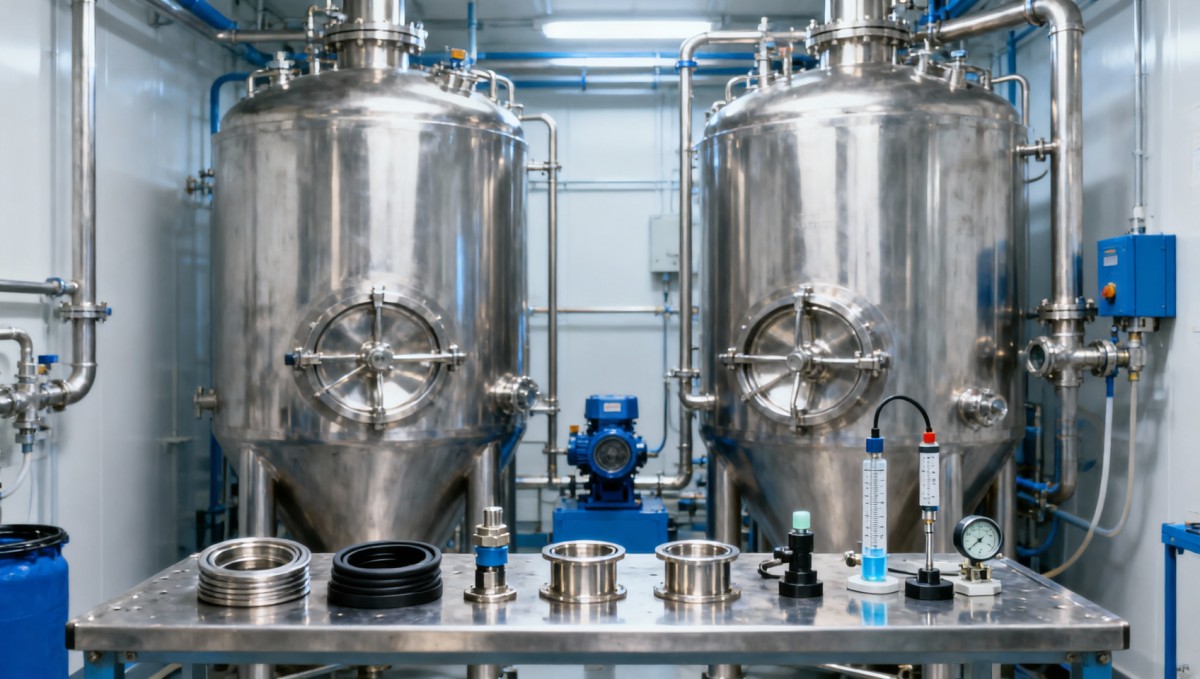
Mechanical maintenance begins with the components exposed to movement, pressure, temperature changes, or repeated cleaning. Depending on the design, these can include agitator seals, bearings, valve diaphragms, gaskets, pump tubing, and feed-pump components. Their replacement intervals should follow manufacturer guidance and documented equipment condition, adjusted through an approved maintenance process when operating evidence supports a change.
A parts price alone gives an incomplete estimate. Replacing a seal may require draining the vessel, gaining access to the assembly, dismantling components, and performing checks before release. The same replacement part can therefore generate different total costs in an accessible laboratory unit and a tightly integrated production installation.
Process conditions also matter. A broth that is viscous, abrasive, or prone to fouling can place different demands on agitation and transfer equipment. Repeated sterilization exposes compatible materials to thermal cycling, while cleaning chemistry affects material suitability. These are reasons to examine the duty of each component rather than assign a maintenance allowance based solely on vessel capacity.
Sensors and calibration
Temperature, pressure, pH, and dissolved-oxygen measurements influence process control and batch decisions. Budget for the applicable calibration work, reference materials, technician time, records, and replacement of instruments or sensing elements that no longer meet acceptance criteria.
Calibration and replacement are separate expenses. An instrument may need checking without needing replacement; another may require repair or replacement after failing a check. Some probes have serviceable components, while others offer fewer repair options. Comparing complete probe prices without understanding the service model can distort the expected annual cost.
The maintenance burden increases when instrument access is difficult or when work must be coordinated with production and quality personnel. For regulated manufacturing, a calibration task may also require controlled records and an assessment of potentially affected batches. The instrument invoice does not capture all of that labor.
Controls and supporting equipment
The vessel depends on its surrounding equipment. Gas delivery, exhaust handling, heating and cooling, sterilization functions, pumps, and automation can each create maintenance costs. The ownership boundary is especially important where a fermentation skid shares plant utilities with other production assets.
A shared steam or cooling system should have an explicit cost-allocation method. Charging its entire maintenance bill to one fermenter overstates that unit’s cost; omitting its contribution understates the resources needed to keep fermentation available.
Control-system support may include troubleshooting, backup verification, replacement of failed hardware, and management of supported software configurations. Any recurring support fee should be checked for scope. Access to technical advice, on-site response, spare hardware, and software changes are different services, and a contract may cover only some of them.

Why scale and process requirements change the estimate
Vessel size helps describe the system, but it is a weak predictor on its own. A more useful comparison combines equipment complexity with operating intensity: how long the equipment runs, how many batches it completes, and how often it undergoes cleaning and sterilization.
For a laboratory fermenter, technician availability and the price of proprietary probes or small replacement assemblies may shape the budget. If usage is intermittent, annual spending can appear modest while maintenance cost per experiment remains high. Several small units also multiply the number of instruments, connections, and service records that need attention.
At pilot scale, the budget must reflect how the equipment is used. Frequent process changes can involve different media, operating conditions, feed arrangements, and cleaning demands. A maintenance estimate based on one stable production recipe may miss the inspection and troubleshooting work associated with development activity.
Production installations bring additional interfaces and scheduling constraints. Maintenance may need to fit into planned shutdowns, coordinate with utility teams, and preserve documented equipment status. An inexpensive part can cause a lengthy interruption if it is inaccessible, unavailable locally, or requires specialist installation and subsequent verification.
Hygiene requirements influence both the work and its consequences. A system used for a contamination-sensitive process may need closer attention to seals, sterile barriers, sampling assemblies, and relevant instrument performance. Where formal qualification is required, certain repairs or changes can trigger additional assessment and testing. The scope depends on the affected function and the facility’s quality requirements; every repair does not automatically demand the same response.
Single-use configurations change the cost distribution. Where disposable assemblies replace reusable wetted components, some cleaning and mechanical maintenance tasks disappear. Recurring assembly purchases then become a larger operating expense, while controllers, drive units, utility connections, and other reusable hardware still need maintenance. Compare the complete cost per usable batch when evaluating the two configurations.
Build a defensible annual estimate
The most useful answer to “what are the maintenance costs for bioengineering fermentation systems?” is an itemized budget with visible assumptions. Begin with an asset list and a task schedule. For each task, record its trigger, expected frequency, parts requirement, labor hours, and any external service or verification work.
A simple calculation is:
Annual planned maintenance cost = scheduled labor + scheduled replacement parts + calibration expenses + contracted service + applicable post-maintenance verification.
Add a separate allowance for corrective work. Keep major overhauls visible as future events instead of burying them in routine annual spending. An annualized overhaul allowance can support lifecycle planning, but the cash budget should still show when the payment is expected.
Consider a hypothetical budgeting exercise. Assume scheduled internal labor totals 120 hours at a fully burdened rate of $100 per hour. Add assumed annual costs of $6,000 for replacement parts, $3,000 for external calibration, and $3,000 for specialist service. Planned maintenance would total $24,000. These figures are calculation inputs, not market prices or an industry benchmark.
If the system completes 80 accepted batches, that assumed budget equals $300 per accepted batch. At 40 accepted batches, it becomes $600. The comparison shows why utilization matters: a similar annual maintenance commitment can produce very different unit economics.
The assumptions need checking for overlap. If the calibration contract includes labor already counted in the internal schedule, remove the duplication. If a service contract excludes travel or replacement parts, add those separately. Use the same approach for shared utilities and quality-team time.
For a new installation, request the manufacturer’s maintenance schedule, priced spare-parts list, calibration requirements, service scope, and expected major service events. For an existing installation, combine those documents with work orders and purchasing records. A year with little maintenance spending may reflect deferred work, so expenditure alone is insufficient evidence of a low-cost system.
Account for downtime without inflating the budget
Equipment-related downtime can outweigh the repair invoice, particularly when a fault destroys a batch or interrupts a constrained production schedule. Yet treating every stoppage as maintenance-related exaggerates the equipment burden. Contamination, for example, can arise from materials, procedures, personnel practices, or equipment faults. Only the relevant share belongs in the maintenance assessment.
Keep direct maintenance spending separate from the cost of disruption. For a credible failure scenario, identify the repair expense, lost materials, additional cleaning and investigation work, and recovery time. Then assess whether delayed production can be recovered later or represents a lasting loss of saleable output.
Avoid counting both lost revenue and lost margin as separate losses from the same output. Similarly, do not assign a full batch loss to a stoppage if the process can resume and the batch remains acceptable. Finance, operations, and quality teams should agree on the treatment before the estimate becomes an investment assumption.
Where failure history is limited, use clearly defined scenarios rather than an unsupported precise failure probability. A planned-service scenario, a repair scenario, and a major-interruption scenario can reveal whether the business needs spare parts, redundant capacity, or stronger service coverage. Update those scenarios as operating records accumulate.
Before accepting a maintenance proposal, resolve four practical questions:
- Which parts, labor, travel, and emergency services are included in the quoted price?
- Which maintenance tasks require production to stop, and how long does return to service take?
- Which critical components have procurement lead times that could extend an outage?
- What checks and documentation are needed after each significant repair?
These answers help distinguish a low service fee from a manageable lifecycle cost. A spare component may justify its carrying cost if it prevents a credible, expensive interruption. Equally, stocking every available part ties up capital without necessarily improving availability.
The final budget should connect expenditure to equipment condition and production needs. Track annual maintenance spending alongside accepted batches, unplanned downtime, repeat faults, and overdue tasks. When cost rises, those measures help identify whether the cause is greater utilization, aging equipment, an unsuitable component, or unresolved failures. That evidence supports the next decision: adjust the maintenance schedule, improve spare-parts coverage, repair a recurring weakness, or replace the asset.
Recommended News
 Nov 10, 2026FDA Requires Vision Loss Warning for GLP-1 MedicinesFDA GLP-1 vision loss warning: Learn what the potential NAION risk means for patients taking Ozempic, Wegovy, Mounjaro and Zepbound.
 Nov 05, 2026How biotech buyers can assess a supplier's manufacturing capacityBiotech industry insights for buyers: learn how to assess supplier capacity, verify production slots and quality release, and reduce supply risks.
 Oct 27, 2026How to compare IP ownership terms across biotech collaborationsUse comparative biotech collaboration analysis to compare IP ownership, licensing, and exit rights. Discover a practical framework to uncover hidden risks and negotiate stronger deals.
 Oct 24, 2026House Panel Backs Treasury Proposal to Restrict Outbound Biotechnology InvestmentOutbound biotechnology investment restrictions: Explore Treasury’s proposed rules, House panel support, and potential implications for biotech financing and China-linked partnerships.
 Nov 15, 2026What Are the Maintenance Costs of Bioengineering Fermentation Systems?What are the maintenance costs for bioengineering fermentation systems? Explore labor, parts, calibration, and downtime costs to build a smarter budget and compare service options.
 Sep 08, 2026Is Bio-Tech Enzyme Production Equipment Standardized Across Suppliers?Is Bio-Tech enzyme production equipment standardized across suppliers? Discover key standards, performance differences, and smart sourcing tips for reliable enzyme production.
 Sep 03, 2026How Do Biotech Cold Chain Requirements Affect Shipping Costs?How do biotechnology cold chain requirements affect shipping costs? Explore packaging, monitoring, customs, and contingency factors that shape smarter biotech logistics budgets.
 Aug 13, 2026Biotechnology Laboratory Research Insights for Faster Method SelectionBiotechnology laboratory research insights for faster method selection: learn how labs compare workflows, reduce validation risk, and choose scalable methods with more confidence.
 Aug 02, 2026How to Evaluate a Biotechnology Research Tracking Tool for Data Integrity and Team CollaborationBiotechnology research tracking tool evaluation starts with data integrity, audit trails, and collaboration risks. Learn what to test before you buy for faster, safer team decisions.
 Jul 12, 2026How to Evaluate a Biotech Alliance Intelligence Provider Before Market ExpansionBiotech alliance intelligence provider selection can define expansion success. Learn how to compare data quality, regional insight, and cross-sector signals before entering new markets.
 Jul 11, 2026Biotechnology Research Category Trends: Which Segments Are Attracting More Funding?Biotechnology research category trends reveal which biotech segments are winning funding, from therapeutics to AI platforms and synthetic biology. Explore the signals shaping smarter market moves.
 Jul 10, 2026Biotech Collaboration for Market Entry: Deal Structures, Risks, and Partner SelectionBiotech collaboration for market entry explained: compare deal structures, assess regulatory and IP risks, and choose the right partner to launch faster with greater control.
 Jul 08, 2026AI-Biotech Collaboration Analysis: Where Drug Discovery Teams Gain the Most Practical ValueAI biotech collaboration analysis reveals where drug discovery teams gain real value—better target selection, faster screening, and smarter lead optimization. Explore practical insights.
 Jul 05, 2026Biotechnology Research Vendor Selection: Key Criteria for Labs Comparing CROs and SuppliersBiotechnology research vendor selection starts with the right criteria. Learn how labs compare CROs and suppliers for quality, compliance, capacity, and cost to reduce risk and choose with confidence.
 Jun 24, 2026Biotech Collaboration Deal Volume: How to Read Partnering Activity and Market SignalsBiotech collaboration deal volume reveals where capital, pipeline demand, and regional strategy are shifting. Learn how to read partnering signals for smarter market insight.
 Jun 20, 2026Veterinary Supplies Purchasing Guide: How to Evaluate Quality, Shelf Life, and CostVeterinary supplies buying guide: learn how to evaluate quality, shelf life, compliance, and total cost to choose reliable suppliers, reduce waste, and make smarter purchasing decisions.
 Apr 16, 2026Biotech solutions with strong science can still face weak adoptionBiotech solutions can fail despite strong science when healthcare resources, usability, and trust lag. Explore lessons from IoT home security, water purifier, and climate technology to speed adoption.
 Apr 16, 2026Why biotech solutions fail to scale from lab to marketBiotech solutions often fail to scale when healthcare resources, compliance, and supply chains lag. Learn how climate technology, CO2 reduction, and sustainable solutions reach market faster.
{item.publish_time}{item.title}{item.description}