


Search News
Global Industrial Intelligence Hub (GIIH)Industry Portal
Global Industrial Intelligence Hub (GIIH)Status
Standard Access
Upgrade to PremiumNewsMedical device cleaning mistakes that affect performance
Time
Click Count
Even small cleaning errors can shorten the life of medical devices, reduce accuracy, and create safety risks for operators and patients. In this guide, we examine the most common medical device cleaning mistakes that affect performance, while also highlighting how maintenance discipline seen in EV motor, EV battery, EV accessories, and EV components management can inspire better handling standards for every medical device.
For operators, technicians, and frontline users, cleaning is not just a hygiene task. It is a performance-control process that affects sensor stability, mechanical motion, electrical safety, and compliance readiness. A device can pass incoming inspection, work well for the first 3 to 6 months, and still fail early if residue, moisture, chemical damage, or poor drying practices accumulate over time.
In hospitals, clinics, laboratories, home-care settings, and mobile service environments, the same pattern appears repeatedly: the device itself is blamed, while the root cause is often improper cleaning technique, inconsistent frequency, or the use of unsuitable agents. Understanding these mistakes helps users protect uptime, reduce recalibration events, and support safer patient-facing operations.
Why Cleaning Errors Directly Affect Medical Device Performance

Medical device cleaning affects more than visible appearance. It influences 4 core performance areas: measurement accuracy, mechanical reliability, electrical integrity, and infection control. A small amount of dried residue on a probe, connector, valve, or contact surface can change readings, increase friction, or create intermittent signal loss. In precision equipment, even a thin film left after wiping may alter response behavior.
Many operators assume that “clean” means “safe to use.” In practice, a device may look clean yet still contain bioburden, detergent residue, trapped moisture, or chemical attack on seals and coatings. These hidden issues can shorten service life by months, especially in devices with repeated daily handling cycles of 10, 20, or even 50 uses per shift.
The same discipline used in EV motor and EV battery maintenance offers a useful lesson. High-value components in electric mobility are managed through controlled procedures, approved materials, inspection intervals, and documentation. Medical devices benefit from the same approach: standard work instructions, defined drying times, and verification steps rather than informal habits.
For B2B operators and procurement teams, cleaning performance also affects cost. A device that needs replacement after 18 months instead of 36 months doubles capital pressure. Frequent sensor drift, cable corrosion, or seal failure also increases downtime, spare-part demand, and operator retraining. Good cleaning practice is therefore part of asset management, not only daily housekeeping.
Hidden Impact Areas Operators Often Miss
- Optical surfaces can lose clarity when cleaned with abrasive wipes more than 1 to 2 times per day.
- Rubber seals may harden early if exposed to incompatible disinfectants for repeated 5 to 10 minute contact cycles.
- Electrical connectors can corrode when moisture remains trapped for as little as 12 to 24 hours.
- Flow channels and hinges may retain residue if flushing or brushing steps are skipped.
Performance Risk Overview
The table below shows how common cleaning-related failures connect to device performance. This is useful for operators who need a fast reference during shift setup, maintenance review, or equipment handover.
The key takeaway is simple: the most damaging cleaning mistakes are often the least visible on day 1. Their effect is cumulative, and by the time performance drops, root-cause tracing becomes harder and more expensive.
The Most Common Medical Device Cleaning Mistakes on the Floor
Operators usually make mistakes under time pressure, not because of negligence. Shift turnover, mixed-device fleets, missing labels, and unclear instructions create inconsistent habits. However, 6 mistakes appear across almost every care and testing environment, from compact diagnostic units to wheeled treatment equipment.
Mistake 1: Using Non-Approved Cleaners
A common assumption is that stronger chemicals clean better. In reality, a cleaner that works for a stainless trolley may damage a polymer housing, touchscreen coating, cable jacket, or adhesive seam. Repeated exposure over 30 to 90 days can discolor surfaces, reduce flexibility, and weaken enclosure protection.
Mistake 2: Over-Wetting the Device
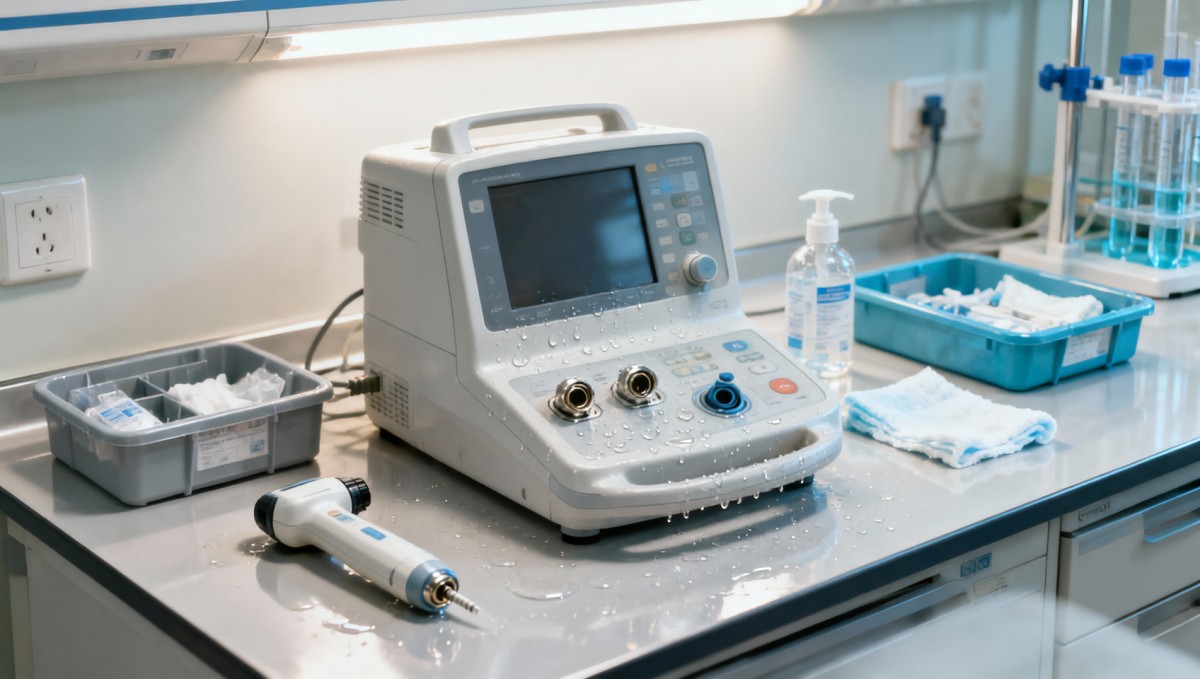
Spraying liquid directly onto monitors, pumps, chargers, handheld tools, or connector zones is one of the fastest ways to create hidden failure. The safer method is usually to apply solution to the wipe first, then clean the surface with controlled moisture. This is especially important around vents, seams, battery doors, and keypads.
Mistake 3: Ignoring Contact Time and Drying Time
Disinfectants often require a set wet-contact period such as 1 minute, 3 minutes, or 10 minutes. If users wipe it off too soon, microbial control may be incomplete. If they power the device back on before full drying, internal moisture risk rises. Effective cleaning requires both the right exposure time and the right recovery time.
Mistake 4: Cleaning Without Disassembly Guidance
Detachable probes, filters, tubing, trays, and caps often need separate cleaning steps. When users clean the outer shell only, residue can remain in hard-to-see channels. If they over-disassemble without guidance, they may stress clips, lose seals, or reassemble the device incorrectly. Both under-cleaning and over-handling can reduce performance.
Mistake 5: Using Abrasive Tools
Scouring pads, hard brushes, and coarse paper towels can create micro-scratches on optical windows, polished metal, and display covers. These scratches trap soil and increase cleaning difficulty over time. After 20 to 40 cleaning cycles, the device may become harder to disinfect and less reliable to inspect visually.
Mistake 6: No Cleaning Log or Frequency Standard
In shared environments, one user assumes the last user cleaned the device, and the next user assumes the same. Without a visible log, shift-based checklist, or digital reminder, cleaning frequency becomes irregular. This creates both hygiene risk and maintenance blind spots.
Fast operator checklist
- Confirm the approved cleaner and dilution before each use.
- Power down and disconnect charging or accessory cables.
- Apply solution to the wipe, not directly to sensitive surfaces.
- Respect the recommended wet-contact and drying period.
- Record cleaning time, user name, and any visible damage in under 60 seconds.
This checklist works because it reduces variation. In high-turnover operations, standardization is often more valuable than speed alone. A process that takes 3 minutes consistently is usually better than one that takes 90 seconds but introduces avoidable damage.
How to Build a Better Cleaning Protocol for Daily Use
A strong cleaning protocol should be easy to follow during busy operations. If the procedure is too long, too technical, or scattered across multiple documents, compliance will fall. The most effective protocols usually fit into 5 to 7 clear steps and include visual cues at the point of use.
Borrowing from EV components management, the best medical equipment programs define approved materials, inspection intervals, failure triggers, and traceable logs. For example, EV battery handling often includes contamination control, connector inspection, and moisture avoidance. Those same principles translate well to medical device cleaning around ports, power systems, and precision interfaces.
Recommended protocol structure
- Step 1: Identify device category: non-critical, semi-critical support equipment, or sensitive electronic device.
- Step 2: Match cleaner type to material compatibility, especially for plastics, elastomers, glass, and coated displays.
- Step 3: Define frequency, such as after every patient use, every 4 hours, or once per shift.
- Step 4: Define drying and restart conditions, including a visible dryness check.
- Step 5: Add a fault-escalation rule if cracking, clouding, corrosion, or seal wear is observed.
The table below provides a practical framework operators can adapt across different device types. It is intentionally operational rather than theoretical, so teams can use it in procurement reviews, SOP creation, or floor-level retraining.
The operational value of this framework is consistency. When users know what to inspect after cleaning, they catch damage earlier. That can reduce unscheduled maintenance events and improve confidence in the device before the next use cycle.
Training and labeling matter more than long manuals
A 1-page visual SOP near the device often works better than a 20-page manual stored elsewhere. Good labels should include 3 essential items: approved cleaner category, no-spray warning zones, and minimum dry time. Refresher training every 6 or 12 months can also reduce variation, especially in facilities with rotating staff.
Selection and Procurement Factors That Support Easier Cleaning
Cleaning performance should be part of the purchasing decision, not an afterthought after installation. Devices that are difficult to clean usually generate higher labor cost, more handling errors, and faster cosmetic or structural wear. For procurement teams and equipment managers, it is smart to evaluate cleaning burden before comparing price alone.
At least 5 factors deserve attention during sourcing: material compatibility, ingress-sensitive design areas, detachable part count, cleaning instruction clarity, and spare-part availability. If two devices deliver similar clinical or operational output, the one with simpler cleaning control may produce lower total cost over a 24 to 48 month lifecycle.
Questions buyers should ask suppliers
- Which disinfectant categories are approved, and which are prohibited?
- Are there any surfaces, ports, or batteries that require special protection during cleaning?
- How many detachable parts must be cleaned separately after standard use?
- What visible signs indicate chemical damage after repeated cycles?
- How quickly can seals, covers, cable sets, or accessories be replaced if damaged?
The table below can support a practical procurement comparison. It is especially useful when teams evaluate multiple medical device options across departments that have different usage intensity, from 5 uses per day in low-volume areas to 40 or more in high-demand environments.
This comparison shows why procurement should involve operators, maintenance staff, and quality teams together. The cheapest unit at purchase can become the most expensive asset if cleaning-related damage causes frequent service calls or shortened replacement intervals.
Cross-industry lesson from EV maintenance culture
In EV accessories and EV component programs, parts are often selected partly for serviceability and contamination control. Medical buyers can use the same logic: choose designs that support safe access, simple wiping, clear labeling, and low-risk reassembly. Service-friendly design reduces both cleaning errors and training burden.
FAQ for Operators: Preventing Cleaning-Related Device Failure
The questions below reflect common search and operational concerns from users who handle medical devices daily. They are especially relevant in mixed fleets, mobile use scenarios, and facilities where several teams share the same equipment.
How often should a medical device be cleaned?
The answer depends on device type, use intensity, and exposure risk. In many environments, visible-touch surfaces are cleaned after each patient use or at least once per shift, while low-contact external surfaces may be reviewed every 4 to 8 hours. High-use devices in triage, testing, or transport settings usually require a tighter routine than equipment in controlled rooms.
Can I use a general disinfectant wipe on every device?
No. A wipe that is acceptable for one device may damage another. Always check compatibility with plastics, coatings, seals, adhesives, and battery compartments. If documentation is unclear, the safest operational decision is to pause and verify with the device supplier or maintenance lead before repeated use over several cleaning cycles.
What are the first warning signs of cleaning damage?
Watch for 6 early indicators: sticky buttons, haze on screens, whitening or brittleness of plastic, cracked seals, green or dark corrosion near connectors, and recurring reading instability after cleaning. Catching these signs in the first 1 to 2 weeks can prevent a larger device failure later.
When should the device be removed from service?
Remove or escalate the device if cleaning exposes internal moisture, causes visible housing damage, affects charging, changes measurement behavior, or prevents proper reassembly. A short hold for inspection is usually less costly than continued use with hidden performance drift or electrical risk.
How can facilities reduce user-to-user inconsistency?
Use a combination of 4 controls: point-of-use labels, approved wipe lists, a short digital or paper log, and refresher training. Facilities that standardize tools and wording usually see fewer mistakes than facilities that rely on verbal handover alone. Consistency is often built through system design, not memory.
Medical device cleaning is a direct performance issue, not a cosmetic task. The most common mistakes—wrong chemicals, excess moisture, poor drying discipline, abrasive tools, and undocumented routines—can reduce accuracy, shorten service life, and create avoidable safety risk. Operators who follow clear, repeatable protocols protect both equipment value and daily reliability.
GIIH continues to track the operational standards, maintenance logic, and cross-industry best practices that help organizations make better equipment decisions. If your team is reviewing medical device handling procedures, evaluating service-friendly equipment, or building a more disciplined maintenance workflow, contact us to get tailored guidance, practical comparison support, and more solution insights.
Recommended News
 Oct 20, 2026AHA Backs Risk-Based Approach in FDA Feedback on Generative AI Medical DevicesAHA backs a risk-based FDA framework for generative AI medical devices. Explore what flexible oversight could mean for patient safety, innovation, and hospital adoption.
 Sep 10, 2026Do Health Monitoring Devices Need Local Approval Before Import?Do health monitoring devices need local regulatory approval before import? Explore classifications, market access, labels, software, and compliance steps for safer global launches.
 Sep 07, 2026How Often Should Medical Information Systems Be Updated for Compliance?How often should medical information systems be updated for compliance? Explore risk-based update schedules, security patches, access reviews, testing, and audit-ready documentation.
 Sep 01, 2026Is Digital Health Data Interoperable Across Hospital Platforms?Is digital health data interoperable across different hospital platforms? Explore standards, security, workflows, and practical steps for safer connected care.
 Aug 31, 2026How to verify a diagnostic medical equipment manufacturer's quality systemDiagnostic medical equipment manufacturer quality system verification: uncover essential checks for ISO 13485, traceability, CAPA, risk management, and supplier control.
![]() Aug 14, 2026China temporarily bans the export of helium, putting global medical and semiconductor supply chains under pressureChina’s temporary helium export ban is straining global medical imaging and chip supply chains. See how MRI, semiconductor, and logistics teams can adapt fast.
 Aug 10, 2026FDA Sets eSTAR Filing Rule for China IVD ExportsFDA Sets eSTAR Filing Rule for China IVD Exports: learn how the new FDA eSTAR requirement affects Chinese IVD manufacturers, compliance documents, and U.S. shipment access.
 Aug 09, 2026Patient Monitoring Equipment Research: Which Metrics Matter Most Before You Buy?Patient monitoring equipment research starts with the right metrics. Learn how to compare accuracy, alarms, connectivity, and lifecycle cost before you buy.
 Jul 28, 2026Healthcare Equipment Research in Europe: Key Market Shifts and Buyer SignalsHealthcare equipment research Europe reveals how regulation, procurement, workflow pressure, and service expectations are reshaping buyer decisions across key healthcare markets.
 Jul 11, 2026Compact Medical Technology Solutions for Small Clinics: What to Compare Before BuyingCompact medical technology solutions for small clinics: compare space fit, throughput, connectivity, maintenance, and long-term cost before you buy. Make a smarter, lower-risk equipment decision.
 Jul 10, 2026Medical Technology Solutions Price Guide: What Drives Cost and How to BudgetMedical technology solutions price guide covering key cost drivers, hidden fees, and smart budgeting methods to compare vendors, control total ownership costs, and approve with confidence.
 Jul 09, 2026Medical Supply Chain Risks: How to Prevent Delays in Regulated Device SourcingMedical supply chain risks can cause costly sourcing delays in regulated devices. Learn practical ways to prevent disruption, improve compliance, and keep global procurement moving.
 Jul 08, 2026Medical Device Specification Analysis: Which Performance Parameters Matter Most in Evaluation?Product specification analysis medical devices starts with the parameters that truly affect safety, accuracy, software readiness, and long-term reliability—learn what to prioritize before you evaluate.
 Jul 06, 2026Medical Regulatory for Devices: Which Certifications Matter Before Market Entry?Medical regulatory for devices starts before launch. Learn which certifications—ISO 13485, CE marking, FDA pathways, and risk standards—matter most for faster, safer market entry.
 Jul 03, 2026Category Comparison Under FDA Requirements: How to Evaluate Product Class DifferencesCategory comparison FDA requirements explained: learn how to assess product class differences, avoid costly pathway mistakes, and make faster, smarter regulatory decisions.
 Jul 02, 2026How to Evaluate a Medical Technology Supplier for Quality, Lead Time, and ComplianceMedical technology supplier evaluation made simple: learn how to compare quality systems, lead time reliability, and compliance readiness to reduce risk and choose with confidence.
 Jul 02, 2026How Diagnostic Medical Equipment Supports Better Care Coordination Across Clinical TeamsDiagnostic medical equipment for care coordination helps clinical teams share data faster, reduce delays, and improve outcomes. See how connected diagnostics strengthen workflow efficiency.
 Jun 28, 2026Healthcare Equipment for Patient Monitoring: How to Choose by Care Setting and Data NeedsHealthcare equipment for patient monitoring: learn how to choose the right solution by care setting, data needs, integration, and lifecycle value for safer, smarter deployment.
 Jun 26, 2026Medical Devices Category Introduction: How Products Are Grouped and Why It MattersMedical devices category introduction: learn how products are grouped, why classifications differ by market, and how smarter category insight improves compliance, sourcing, and global market entry.
 Jun 26, 2026Medical Technology Solutions for Healthcare Facilities: What to Evaluate Before BuyingMedical technology solutions for healthcare facilities: learn what to evaluate before buying, from clinical fit and integration to compliance, vendor support, and total cost.
 Jun 25, 2026Surgical Instruments Materials Compared: Stainless Steel, Titanium, and MoreSurgical instruments materials compared: explore stainless steel, titanium, tungsten carbide, and coatings to improve durability, safety, sterilization performance, and smarter sourcing decisions.
 Jun 25, 2026Diagnostic Medical Equipment for Preventive Care: What Clinics Should PrioritizeDiagnostic medical equipment for preventive care: discover what clinics should prioritize to improve early detection, streamline workflows, control costs, and support long-term growth.
 Jun 23, 2026Hospital Furniture Standards: What to Check for Safety, Hygiene, and Ward UseHospital furniture standards explained: learn what to check for safety, hygiene, load capacity, ward fit, and supplier proof before buying for reliable long-term performance.
 Jun 22, 2026How to Choose Blood Pressure Monitors for Home Use: Cuff Size, Accuracy, and MemoryBlood pressure monitors for home use vary in cuff size, accuracy, and memory. Learn how to compare features, avoid common mistakes, and choose a reliable monitor with confidence.