


Search News
Global Industrial Intelligence Hub (GIIH)Industry Portal
Global Industrial Intelligence Hub (GIIH)Status
Standard Access
Upgrade to PremiumNewsHow remote healthcare technology keeps care teams aligned
Time
Click Count
A patient may be discharged from hospital with a revised medication list, a follow-up appointment, and instructions for a home-monitoring device. Yet the primary care clinician, specialist, nurse coordinator, and family caregiver may not receive the same information at the same time. In another common situation, a virtual visit identifies a worsening symptom, but the observation remains in a video platform note rather than reaching the person responsible for changing the care plan.
Remote healthcare technology keeps care teams aligned when it turns separate interactions into a shared, actionable workflow. Video consultations alone do not create coordination. The useful systems connect clinical information, route tasks to the right role, show what has been acknowledged, and preserve context as a patient moves between home, clinic, hospital, pharmacy, and community services. Remote healthcare technology for care coordination is therefore less about replacing in-person care than about making decisions, responsibilities, and follow-up visible across locations.
Alignment breaks down at the handoffs, not only during appointments
Distributed care creates more handoffs than a single-site model. A clinician may review remote blood pressure readings in the morning, a nurse may call the patient later that day, and a specialist may adjust treatment after a virtual follow-up. Each action can be appropriate on its own. Problems arise when the team cannot see the latest decision, cannot tell who owns the next step, or receives information without enough clinical context.
These gaps are easy to underestimate because communication still appears to be happening. Messages are sent, notes are filed, calls are completed, and devices transmit data. But a care team is not aligned merely because information exists somewhere. Alignment requires answers to practical questions:
- What changed in the patient’s condition or treatment?
- Who has reviewed the change, and who still needs to act?
- Is the finding urgent, routine, or awaiting confirmation?
- What follow-up is due, and what should happen if it is missed?
- Can the next clinician understand the decision without reconstructing the whole history?
Remote tools are most valuable when they address these questions in the normal course of work. A system that creates another inbox, another login, or another unstructured stream of alerts can increase fragmentation even while adding digital access.
The technologies behind coordinated remote care
Care coordination usually depends on a combination of tools rather than one application. Their roles overlap, but each solves a different part of the workflow.
Virtual visit platforms create a shared clinical encounter
Video and audio consultations allow clinicians to assess patients who cannot easily travel, involve a caregiver from another location, or bring multiple professionals into the same conversation. Their coordination value comes from what happens around the call: identity verification, documentation, medication review, orders, referral routing, and follow-up scheduling.
A virtual visit is more likely to support team alignment when the note records the clinical decision, outstanding questions, named follow-up owner, and escalation instructions. A brief record stating that a consultation occurred is rarely enough for a colleague who must act later.
Shared records and interoperability preserve clinical context
A longitudinal electronic health record can give authorized team members access to diagnoses, allergies, medications, results, care plans, and prior communications. Interoperability matters when remote tools collect information outside that record. Remote monitoring data, consultation summaries, and patient-reported symptoms need to appear in a usable form where clinical work is already managed.
This does not mean every data point should be copied into every system. Raw, high-frequency readings may be difficult to interpret and can obscure important changes. A better design distinguishes between data that should be stored, data that should trigger review, and data that should be summarized for the broader team. Context such as measurement time, device status, symptom reports, and recent medication changes often matters as much as the number itself.
Secure messaging supports short, traceable decisions
Phone calls remain useful, especially for urgent clarification, but they can be difficult to document consistently. Secure clinical messaging can make routine coordination more visible by preserving a time-stamped exchange within the appropriate patient context. It works well for focused communication: confirming that a result was reviewed, asking whether a medication has been started, or handing an issue to a designated colleague.
The limitation is that messaging should not become a substitute for task ownership. A message sent to a group may be seen by several people and acted on by no one. Effective workflows use clear recipients, response expectations, and escalation paths for messages that cannot wait.
Remote patient monitoring turns home observations into managed signals
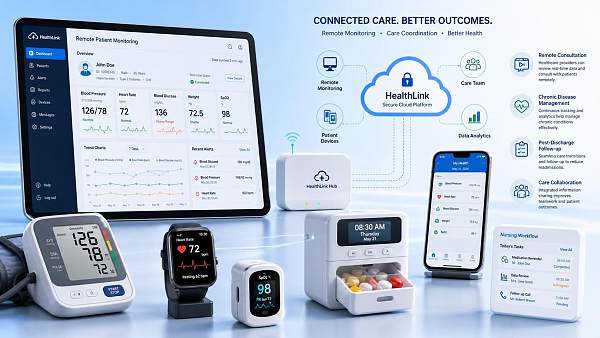
Connected devices and patient-reported outcome tools can extend observation beyond the clinic. Blood pressure, weight, glucose readings, oxygen saturation, symptom changes, activity measures, or treatment adherence may be relevant depending on the care plan. Their value is not continuous surveillance. It is the ability to identify a meaningful change early enough for the right member of the team to respond.
For this to work, teams need agreed thresholds and a realistic review model. An alert that reaches a clinician without information about baseline status, recent symptoms, or who has contacted the patient may lead to duplicated work. Conversely, an alert policy that is too broad can create alarm fatigue, making meaningful deterioration harder to identify.
Task and referral management makes responsibility explicit
Coordination frequently fails after the clinical decision has already been made. A referral is placed but not scheduled, a test is ordered but not followed up, or a patient needs education but no one is assigned to provide it. Task-management functions make these next steps trackable. They can assign work, set due dates, record completion, and return unfinished tasks for review.
The important distinction is between a notification and a task. A notification tells someone that something occurred. A task identifies a required action, an owner, a deadline, and a completion state. Remote care programs need both, but confusing them leaves too much to memory and informal follow-up.
A practical workflow: from remote signal to closed loop
Consider a patient who submits a home reading or reports a new symptom through a remote channel. The technology should support a defined sequence rather than simply pass the information onward.
- Capture the information with enough context. The system should associate the reading or report with the correct patient and indicate when it was collected. Where relevant, it should capture symptoms, device issues, or whether the measurement was repeated.
- Apply a clinically agreed review rule. Not every submission needs the same urgency. Rules may direct routine values into a summary, flag a value for scheduled review, or create an immediate escalation.
- Route the item to an accountable role. The recipient should be determined by the care pathway, not by whoever happens to be available. Some items belong with a monitoring nurse, some with a prescribing clinician, and some with administrative support.
- Document the assessment and decision. A response should show what was reviewed, what action was taken, and whether the patient was contacted. This allows subsequent team members to understand the situation without relying on verbal handover.
- Communicate the plan in an appropriate channel. The patient may need instructions, while another clinician may need a concise update or an order. The message should match the recipient’s role and avoid exposing unnecessary information.
- Verify closure. The workflow should show whether the medication was changed, appointment booked, education delivered, or escalation completed. If the patient cannot be reached, that fact should generate a defined next action rather than silently ending the process.
This closed-loop approach is especially important when several organizations participate in care. A remote program can identify an issue, but continuity depends on whether the receiving clinician can access the relevant finding and whether responsibility has been accepted.
Where teams often choose the wrong tool
A frequent mistake is selecting technology according to the most visible activity rather than the coordination failure. When the issue is delayed follow-up, adding a more polished video interface may not help. When the issue is inconsistent clinical context, expanding message volume can make matters worse. The first question should be: where does the handoff currently fail?
The table does not imply that every organization needs every capability at once. A small program may improve alignment substantially by standardizing documentation and assigning follow-up ownership before introducing advanced monitoring. Technology works best when it reinforces a workflow the team can realistically sustain.
Information quality matters more than information volume
Remote care can generate a large amount of material: device readings, chat messages, visit recordings, forms, notifications, and care notes. More information does not automatically improve decisions. Clinicians need material that is timely, relevant, interpretable, and linked to a clear action.
Teams should decide which information belongs in a shared care plan, which should be summarized periodically, and which requires immediate notification. For example, a trend may be more useful than a single isolated reading; a symptom report may need to appear alongside recent treatment changes; and an unanswered message may require a different response from a completed patient interaction.
Role-based views can help reduce noise. A care coordinator may need a queue of overdue outreach tasks, while a specialist may need concise clinical trends and unresolved decision points. Giving every user the same unfiltered dashboard often results in missed priorities rather than better visibility.
Implementation questions that reveal whether a workflow is ready
Before adopting or expanding remote tools, care teams can examine a few operational details. These questions are more revealing than a feature list because they expose where a process relies on assumption.
- Can a clinician identify the current care plan and most recent decision without searching across several systems?
- Does every alert category have a named owner, coverage arrangement, and expected response time?
- Can team members distinguish a completed task from a message that was merely read?
- What happens when a patient does not respond, cannot use the technology, or submits questionable device data?
- Are medication changes reconciled across virtual visits, discharge documents, pharmacy communications, and the shared record?
- Can the organization audit whether urgent items were acknowledged and escalated appropriately?
These are not only technical questions. They require agreement on scope of practice, staffing, clinical thresholds, and communication etiquette. A system cannot resolve uncertainty that the care pathway itself has not defined.
Privacy, access, and safety cannot be added after the workflow is built
Remote coordination involves sensitive health information moving across devices, networks, and organizations. Access controls should reflect the user’s role and the minimum information needed to perform the task. Authentication, audit trails, secure transmission, device management, and procedures for lost or shared devices all affect whether a workflow can be used safely.
Patient access also needs careful design. Some people may have limited connectivity, language barriers, disabilities, low digital confidence, or no private space for virtual consultations. A coordinated model should offer alternatives rather than assuming that an app-based pathway works for everyone. Telephone outreach, interpreter support, accessible instructions, and clear routes back to in-person care may be necessary parts of the same service.
Clinical safety depends on setting expectations about the limits of remote channels. Patients need to know which symptoms or situations require urgent in-person assessment rather than waiting for a portal response. Staff need guidance on what to do when incoming information is incomplete, contradictory, or outside the program’s monitoring hours.
What good alignment looks like in daily practice
Well-coordinated remote care is often quiet. The patient does not have to repeat a medication change to each professional. The nurse reviewing a home alert can see the relevant plan and knows when to escalate. The clinician receiving a virtual-visit summary can tell what has already been decided and what remains open. Follow-up does not rely solely on an individual remembering to make another call.
The lasting value of remote healthcare technology comes from this dependable continuity. When tools are connected to clear responsibilities, meaningful clinical context, and closed-loop follow-up, they help care teams work from the same picture even when they are not in the same place.
Recommended News
 Oct 08, 2026How remote healthcare technology keeps care teams alignedRemote healthcare technology for care coordination keeps teams aligned through shared workflows, clear task ownership, and closed-loop follow-up. Explore practical strategies.
 Oct 07, 2026How to evaluate a medical advice resource before relying on itMedical advice resource guide: learn how to check authors, evidence, dates, bias, and safety limits before relying on online health information.
 Sep 15, 2026How to assess a digital health vendor’s interoperability before signingAssess a digital health vendor’s interoperability with practical checks for APIs, data quality, security, governance, and real-world clinical workflows before signing.
 Sep 04, 2026How digital clinical technology insights can reduce care delaysDigital clinical technology insights help healthcare teams identify bottlenecks, improve accountability, and reduce care delays with actionable workflow intelligence.
 Sep 06, 2026Can Virtual Doctor Visits Replace In-Person Chronic Care?Can virtual doctor visits replace in-person consultations for chronic care? Discover how hybrid care improves access, monitoring, safety, and long-term outcomes.
 Aug 26, 2026What determines online medical consultation pricing across platformsOnline medical consultation pricing varies by doctor expertise, visit format, speed, regulation, and follow-up. Learn how to compare platforms, spot hidden fees, and choose better-value telehealth care.
 Jul 21, 2026How Remote Healthcare Solutions Improve Access and Care Coordination for ProvidersRemote healthcare solutions help providers expand access, strengthen care coordination, and improve follow-up across settings. See how smarter workflows reduce gaps and support better outcomes.
 Jul 12, 2026How to Calculate Remote Healthcare Technology Total Cost Before DeploymentRemote healthcare technology total cost explained: learn how to calculate deployment, integration, compliance, support, and 3–5 year operating expenses before approval.
 Jul 05, 2026Remote Healthcare Technology Quality Standards: What Buyers Should Verify Before ApprovalRemote healthcare technology quality standards define whether digital care is truly safe, secure, and approval-ready. Discover what buyers must verify before selecting vendors.
 Jul 04, 2026Remote Healthcare Technology for Hospitals: Use Cases, Integration, and ROI FactorsRemote healthcare technology for hospitals: explore top use cases, integration needs, and ROI drivers to help hospital leaders choose scalable, high-impact digital care solutions.
 Jul 03, 2026How to Use Health Insights to Improve Cross-Functional Project CoordinationHealth insights can reveal hidden risks, handoff gaps, and decision delays in cross-functional projects. Learn practical ways to improve coordination, speed response, and reduce costly rework.
 Jul 01, 2026How Remote Healthcare Technology Wireless Systems Support Chronic Care at HomeRemote healthcare technology wireless systems help providers deliver safer chronic care at home with real-time monitoring, early alerts, and better patient support—discover key benefits and use cases.
 Jun 30, 2026Why Low Latency Matters in Remote Healthcare Technology for Monitoring and ConsultsRemote healthcare technology low latency is crucial for safer monitoring and smoother virtual consults. Learn how faster data and alerts improve care quality, workflows, and scaling decisions.
 Jun 29, 2026Medical Technology Solutions for Telehealth: Which Devices Fit Remote Care Workflows?Medical technology solutions for telehealth work best when matched to real care workflows. Learn which devices improve remote monitoring, virtual visits, and post-discharge outcomes.
 Jun 26, 2026Remote Healthcare Technology Digital Therapeutics: Use Cases and Limits in Care DeliveryRemote healthcare technology digital therapeutics explained through real use cases, care delivery limits, and scaling risks. See where adoption creates value and what decision-makers must validate before rollout.
 Jun 24, 2026What Is Healthcare Informatics and How Is It Used in Hospitals and Telehealth?Healthcare informatics powers smarter hospitals and telehealth by connecting data, workflows, and clinical decisions. Discover how it improves care, safety, and coordination.
 Jun 20, 2026Nebulizers for Home Use: Mesh vs Jet vs Ultrasonic and Which One Fits Your NeedsNebulizers for home use compared: mesh, jet, and ultrasonic models explained by noise, portability, cost, and care needs—find the best fit for your routine and breathe easier.
 Jun 14, 2026How to Use Health Insights to Spot Care Gaps, Readmission Risk, and Patient TrendsHealth insights help healthcare teams spot care gaps, identify readmission risk, and track patient trends faster—turning complex data into smarter action, better outcomes, and stronger operational planning.
 Jun 13, 2026Online Medical Consultation vs In-Person Visits: Which Conditions Are Suitable for Each?Online medical consultation explained: discover which conditions are safe for virtual care, when in-person visits are essential, and how to choose the right option quickly and confidently.
 Jun 11, 2026Portable Oxygen Concentrators vs Oxygen Cylinders: Which Option Fits Home and Travel Use?Portable oxygen concentrators vs oxygen cylinders: compare mobility, travel convenience, backup reliability, and long-term cost to find the best oxygen solution for home and travel use.
 Jun 03, 2026Healthcare Informatics in Hospitals: Data Integration, Security, and Workflow Use CasesHealthcare informatics helps hospitals integrate data, strengthen security, and streamline workflows. Explore practical use cases for safer, faster care.
 May 22, 2026Can telemedicine hardware work well in rural areas?Telemedicine hardware for rural areas can deliver reliable care when matched to real-world power, network, and workflow needs. Explore the key checklist for smarter deployment.
 May 21, 2026What matters most in portable telemedicine hardwareTelemedicine hardware portable devices: learn what really matters for selection—clinical accuracy, secure connectivity, interoperability, durability, and lower long-term risk.
 May 20, 2026How telemedicine hardware improves hospital response timeTelemedicine hardware for hospitals helps reduce response time with faster consults, reliable monitoring, and better care coordination. Explore the checklist that helps hospitals choose smarter.