


Search News
Global Industrial Intelligence Hub (GIIH)Industry Portal
Global Industrial Intelligence Hub (GIIH)Status
Standard Access
Upgrade to PremiumNewsWhen does modular systems furniture customization justify its cost?
Time
Click Count
The decision is about change, not just furniture
For business evaluators, modular systems furniture customization is justified when its long-term gains outweigh the initial premium. The right solution can improve space utilization, support workforce changes, strengthen brand consistency, and reduce future reconfiguration costs. The wrong solution, however, can turn a flexible workplace concept into an expensive collection of proprietary parts that are difficult to modify, repair, or redeploy.
This distinction matters because the purchasing question is often framed too narrowly: “What will the furniture cost?” A more useful question is: “What operating problems will this system remove over the next five to ten years, and what new dependencies will it create?”
Customized modular furniture sits between two familiar options. Standard loose furniture is quick to buy, easy to compare, and usually inexpensive upfront, but it can produce uneven layouts, wasted circulation space, and repeated replacement costs as teams expand or contract. Fully bespoke built-ins can create a highly tailored environment, but they are costly and usually difficult to relocate. A modular system aims to preserve some of the fit and consistency of bespoke work while retaining the ability to add, remove, move, or repurpose components.
That promise is real only when the organization has a credible need for repeatable change. For a stable, small office with limited technical requirements, customization may be unnecessary. For a multi-site operation, a growing support center, a hybrid office, a healthcare administration unit, a training facility, or a logistics control room, it may become an operational asset rather than a design expense.
Start with the cost of the current problem
A customized system should not be approved simply because it looks more organized or carries a stronger design narrative. It should address measurable constraints in the existing workplace or planned facility. Those constraints commonly fall into four categories: capacity, infrastructure, workflow, and governance.
Capacity is the most obvious. Organizations may need to accommodate more people within an existing footprint, create touchdown areas for hybrid staff, or convert underused rooms into project spaces. In these cases, a modular system can deliver value through denser but still usable planning. The key is not maximizing the number of desks. It is maximizing the amount of productive work the site can support without increasing noise, congestion, safety risk, or employee dissatisfaction.
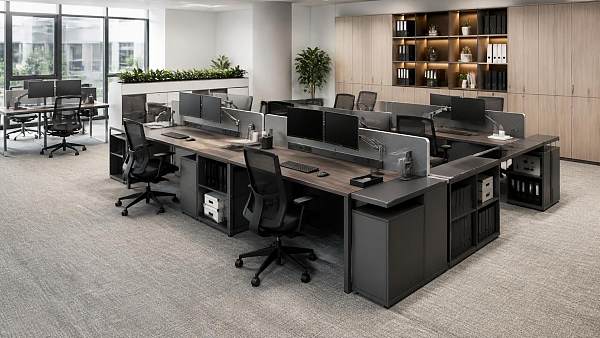
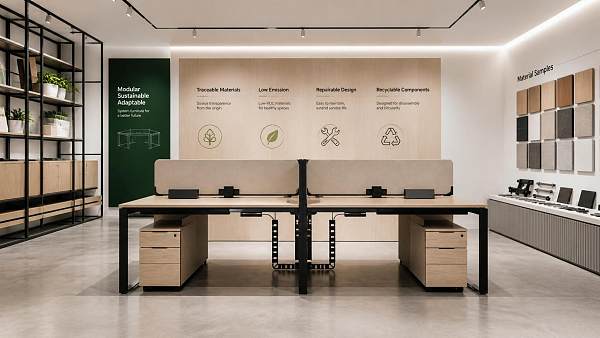
Infrastructure is often the more expensive issue. In office and operational environments, power, data, charging, monitor arms, cable routing, storage, acoustic separation, and lighting all influence whether a workstation is genuinely usable. A lower-cost desk may appear competitive until facilities teams must add cable trays, relocate outlets, buy incompatible accessories, or manage exposed wiring after every layout change. A systems solution can centralize these elements, provided that its electrical and data strategy has been reviewed early.
Workflow concerns are less visible during a showroom visit but often determine whether the investment performs. Customer-service teams may need supervision sightlines and acoustic moderation. Engineering groups may need large shared surfaces and easy access to technical equipment. Procurement and finance functions may require secure storage. Training spaces may need to shift between classroom, team, and individual work modes. Customization earns its place when it supports these activities without forcing staff into workarounds.
Governance is particularly relevant for organizations with multiple locations. A common modular platform can create a repeatable standard for workstation dimensions, storage, cable management, finish selections, and replacement parts. That can simplify budgets, reduce design variation, and make acquisitions or new-site openings easier to execute. But standardization has value only when the organization is willing to manage it centrally. Without clear ownership, sites may customize independently until the supposed system becomes a patchwork.

Where the premium is usually justified
The strongest business case appears where future movement is predictable, even if the exact future layout is not. A company does not need to know precisely how every team will sit three years from now. It does need reasonable confidence that headcount, team composition, technology, or operating models will change often enough to make fixed furniture a recurring cost.
Multi-site and phased rollouts
For organizations opening branches, consolidating offices, or refreshing locations in stages, a consistent modular kit can reduce repeated design decisions. A standard set of planning rules can be adapted to local footprints while preserving comparable user experience and operational requirements. This may also improve sourcing discipline: instead of procuring a new mix of furniture for every site, the buyer can negotiate service levels, lead times, spare-part availability, and pricing logic across a defined product family.
The caveat is that global consistency should not ignore local conditions. Building codes, electrical practices, fire requirements, accessibility rules, freight constraints, and installer capability differ by market. International buyers should validate the local compliance pathway and installation responsibility before treating a global product specification as deployable everywhere. Certifications, material claims, and regulatory applicability should be verified for each destination rather than assumed from a supplier’s general documentation.
High-churn teams and hybrid work
Departments with fluctuating headcount can benefit when workstations, storage, privacy screens, and meeting settings can be reallocated with limited disruption. This is especially relevant where desk allocation is no longer fixed. A hybrid workplace may need fewer assigned desks but more varied settings: focused work points, team tables, enclosed calls, lockers, and short-duration collaboration zones.
Here, the value is not necessarily a reduction in furniture quantity. It is the ability to alter the mix of settings without discarding the underlying platform. A system that allows a bank of desks to become a project zone, or enables storage and screens to be repositioned as teams change, can reduce waste. Yet buyers should test how much work a “reconfiguration” actually involves. If every adjustment requires specialized installers, electrical shutdowns, new parts, and long lead times, flexibility may exist only on paper.
Operationally demanding settings
Call centers, control rooms, technical support teams, laboratories with office components, healthcare administration areas, and dispatch operations are more likely to justify custom configuration because furniture directly affects task performance. Monitor placement, reach zones, device integration, privacy, durability, cleanability, and cable access can all affect daily output and maintenance burden.
In these settings, a generic workstation can create hidden costs through ergonomic complaints, equipment damage, clutter, difficult cleaning, or slow handovers between shifts. The procurement team should involve users, IT, facilities, health and safety representatives, and maintenance staff before finalizing specifications. The people who repair a system and the people who work in it will identify different risks, both of which matter.
When customization is unlikely to pay back
Not every organization benefits from a customized modular approach. The most common overinvestment occurs when a buyer purchases flexibility without a realistic reconfiguration plan. Furniture is sometimes used as a substitute for unresolved workplace strategy: leadership has not decided how teams will work, so the project tries to make every possible option available. The result can be an overly complicated specification with costly components that are rarely moved.
Customization is also difficult to justify in short leases where relocation rights are uncertain, in small offices with low headcount volatility, or in businesses whose needs are adequately met by high-quality standard furniture. In those cases, buying durable, repairable, readily available items may be financially stronger than building a complex system.
A further warning sign is an unusually narrow supplier ecosystem. Some proprietary systems make future additions dependent on one manufacturer, one dealer network, or a limited set of authorized installers. That is not automatically unacceptable. A closed system may offer better fit, performance, and accountability. But the dependency should be priced as a commercial risk, especially when the expected life of the installation exceeds the initial contract period.
- Do not assume “modular” means components from different suppliers will connect or match.
- Do not treat visual compatibility as technical compatibility for power, data, screens, storage, or mounting hardware.
- Do not assume a favorable initial quotation covers future moves, replacement finishes, discontinued parts, or installer callouts.
- Do not count projected space savings unless the released area has a credible use, such as avoiding a lease expansion or accommodating a defined function.
Build the financial case around total ownership
Comparing purchase prices alone tends to favor standard furniture. A sound evaluation compares expected total cost over the intended life of the facility. The calculation does not need false precision, but it should make assumptions visible.
Start with the initial cost: product, design, site measurement, project management, delivery, installation, electrical coordination, IT integration, and any building work required. Then add the cost of change: expected internal moves, expansion, relocation, storage of unused parts, replacement components, maintenance, and disposal or resale. Finally, consider avoided costs, such as fewer ad hoc furniture purchases, reduced downtime during moves, lower fit-out work during reorganization, or deferred real-estate expansion.
Productivity benefits should be handled carefully. Better acoustics, ergonomics, and organization may improve employee experience, but it is difficult to assign a precise monetary outcome without internal evidence. Instead of claiming a generic productivity percentage, evaluators can identify operational indicators that are already tracked: workstation-related service tickets, move-request completion time, equipment incidents, space utilization, absenteeism patterns, or employee feedback on focus and privacy. These do not prove causation on their own, but they create a more credible baseline for later review.
The appropriate comparison is usually not “custom modular versus no cost.” It is “custom modular versus the likely sequence of standard purchases, alterations, and disruptions under the organization’s actual growth scenario.” This is why scenario planning matters. A buyer may test a stable case, a moderate-change case, and a high-growth or relocation case. If customization only works financially under an aggressive expansion assumption, the decision should be treated as strategic risk-taking rather than an obvious efficiency measure.
Specify flexibility in operational terms
Vendors frequently describe systems as adaptable, scalable, or future-ready. Those terms are too broad for a procurement specification. The evaluation team should translate them into operational questions that can be demonstrated, priced, and included in a contract.
- Which components can a trained facilities team move internally, and which require certified installers?
- How long does it take to convert a representative team zone from one layout to another?
- What tools, labor, electrical work, and replacement parts are required?
- Can power and data modules be changed independently of work surfaces and frames?
- Which parts are expected to remain available, and for how long?
- Can damaged panels, tops, screens, casters, and fittings be replaced individually?
- What happens when a finish, fabric, or product line is discontinued?
- What information will the buyer receive for asset records, installation drawings, maintenance, and future reconfiguration?
These questions are especially important in competitive tenders. A low bid may reflect a more limited configuration, fewer included accessories, weaker post-installation support, or assumptions that transfer responsibilities back to the buyer. Bid normalization should compare like with like, including installation scope, warranty terms, spare parts, lead times, and change-order rates.
Design and procurement need the same brief
Furniture decisions often fail at the handoff between design intent and operational procurement. Designers may prioritize visual coherence and user experience. Procurement may focus on commercial terms and supplier risk. Facilities may be concerned with maintainability, while IT needs dependable power and cable access. Each perspective is valid, but a modular systems project should be governed through one shared brief.
That brief should define the business purpose of customization, non-negotiable technical requirements, expected change scenarios, budget boundaries, approval authority for variations, and measures of post-occupancy success. It should also distinguish what must be standardized from what can remain locally adaptable. For example, desk frames, power modules, and core finish families may need central control, while selected accessories or collaboration settings may vary by team function.
For large programs, a pilot installation is usually more informative than extensive catalog review. A pilot should be operated long enough to reveal cable-management issues, cleaning challenges, noise behavior, storage demand, and user habits. The critical test is not whether the space photographs well on opening day. It is whether the organization can make an ordinary change to it without disproportionate cost or disruption.
The decision threshold
Modular systems furniture customization is worth its cost when the buyer can identify a recurring business need for change, quantify at least some of the costs avoided by that flexibility, and secure a supply and service model that will remain workable over time. It is strongest where space, infrastructure, and workflow are closely connected, and where the organization has enough scale or complexity to benefit from a common operating standard.
It is less compelling when flexibility is merely aspirational, the lease horizon is short, future changes are unlikely, or the supplier’s proprietary model creates unmanaged dependence. The durable decision is not to buy the most configurable system available. It is to buy the level of configurability that the business can realistically use, maintain, and govern.
Recommended News
 Sep 19, 2026When project planning support prevents costly delays in complex projectsProject planning support helps complex teams expose critical dependencies, protect schedule float, and prevent costly delays before risks become irreversible problems.
 Sep 18, 2026How to size industrial compressors for fluctuating air demandIndustrial compressors for fluctuating air demand: learn how to size capacity, storage, controls, and pressure recovery for reliable, energy-efficient performance.
 Sep 14, 2026How a material selection analysis guide reduces failure riskMaterial selection analysis guide: reduce failure risk with practical steps for performance, manufacturing, compliance, and supply-chain decisions.
 Sep 13, 2026What drives procurement research platform cost for enterprise teams?Procurement research platform cost explained: assess data quality, coverage, licensing, hidden costs, and ROI to make confident enterprise sourcing decisions.
 Sep 11, 2026How an industrial market analysis framework supports investment decisionsIndustrial market analysis framework: turn demand, competition, supply-chain risk, and regulation into smarter, resilient investment decisions.
 Sep 07, 2026What to look for in a material selection analysis providerDiscover how to choose a material selection analysis provider with proven engineering expertise, traceable data, validation capabilities, compliance insight, and supply-chain intelligence.
 Sep 03, 2026When do mobility control components need redundant safety features?Mobility control components need redundant safety features when one failure could cause hazardous motion. Learn how to build independent, testable protection.
 Sep 02, 2026How to use an industrial market analysis database for market sizingLearn how an industrial market analysis database supports accurate market sizing through clear boundaries, data triangulation, classification mapping, and actionable insights.
 Sep 01, 2026How a performance factor analysis platform reveals operational bottlenecksPerformance factor analysis platform insights help teams uncover hidden operational bottlenecks, validate root causes, and improve throughput across complex operations.
 Sep 19, 2026Is modular systems furniture practical for growing offices?Modular systems furniture for offices helps growing teams scale efficiently. Explore costs, flexibility, privacy, and implementation tips for smarter workspace decisions.
 Sep 17, 2026How to size a modular systems furniture workstation for daily useModular systems furniture workstation sizing guide: optimize desk space, ergonomics, circulation, power capacity, and flexibility for productive daily use.
 Sep 16, 2026How much storage can modular systems furniture add to a workspace?Modular systems furniture storage can unlock usable workspace capacity. Explore smart layouts, flexible modules, and practical planning tips for efficient, scalable organization.
 Sep 15, 2026When does modular systems furniture customization justify its cost?Modular systems furniture customization: learn when flexibility, lifecycle savings, and scalable workplace design justify the investment.
 Sep 14, 2026What should installation plans cover for modular systems furniture?Modular systems furniture installation plans should cover scope, site verification, logistics, safety, power coordination, quality checks, and handover for a seamless workspace launch.
 Sep 13, 2026What drives modular systems furniture price in office projects?Modular systems furniture price explained: uncover layout, materials, power, installation, and lifecycle factors to budget smarter and build adaptable offices.
 Sep 12, 2026How to verify sustainable materials in modular systems furnitureModular systems furniture sustainable materials: learn how to verify sourcing, emissions, certifications, and repairability with a practical supplier checklist.
 Aug 29, 2026Which pricing trends matter most when comparing product categories?Pricing trends reveal more than unit costs. Learn how to compare categories by cost drivers, lifecycle value, regional gaps, technology shifts, and discounts.
 Aug 28, 2026When does energy-efficient design reduce lifetime operating costs?Energy-efficient design can cut lifetime operating costs when real savings outweigh capital, maintenance, and reliability risks. Learn how to assess TCO, tariffs, utilization, and payback.
 Aug 27, 2026When does wholesale structural steel make sense for a project?Structural steel beams wholesale can reduce total project risk when demand is stable. Discover how to balance cost, quality, phased delivery, and traceability.
 Sep 03, 2026How Operating Pressure in PSI Affects Poultry Nipple Drinker PerformancePoultry nipple drinker operating pressure PSI manufacturer guide: optimize flow, prevent leaks, and ensure reliable water delivery across every line.
 Aug 22, 2026When weighted performance factor analysis improves vendor selectionWeighted performance factor analysis improves vendor selection when quality, compliance, delivery, and lifecycle risk matter more than price alone. Learn when this method creates smarter, defensible sourcing decisions.
 Aug 16, 2026How to verify hotel automation PCB assembly specs before supplier approvalHotel automation PCB assembly specs should be verified before supplier approval by checking DFM, testing, traceability, and compliance—learn the key steps to avoid field failures.
 Aug 15, 2026How does market trend analysis affect price expectations?Market trend analysis price insights help you set smarter expectations, spot real price shifts, and make faster, more confident pricing decisions.
 Aug 12, 2026Device Performance Factor Analysis: Which Variables Matter Most in Evaluation?Device performance factor analysis reveals which variables truly drive stability, repeatability, thermal behavior, power quality, and field results—read the key factors that matter most.