


Search News
Global Industrial Intelligence Hub (GIIH)Industry Portal
Global Industrial Intelligence Hub (GIIH)Status
Standard Access
Upgrade to PremiumNewsVehicle Electronics Selection Guide: Key Standards, Interfaces, and Reliability Factors
Time
Click Count
Selecting vehicle electronics is no longer a matter of comparing headline functions or unit price alone. In current automotive and mobility programs, every controller, sensor, display, connector, and communication module sits inside a tighter network of safety rules, software dependencies, supply chain risks, and lifecycle expectations. That is why a practical selection guide must connect standards, interfaces, and reliability into one evaluation framework rather than treat them as separate checkboxes.
This matters even more in a market shaped by electrification, connected services, regional compliance pressure, and longer data responsibilities. From the perspective of industrial intelligence platforms such as GIIH, the real value lies in turning scattered technical details into comparable decision signals. In vehicle electronics, that means understanding not only what a component can do, but also how well it integrates, how long it remains stable, and what hidden costs it may create after launch.
Why vehicle electronics selection has become a strategic issue
Vehicle architectures are changing fast. Traditional distributed systems now coexist with domain control, zonal design, centralized computing, and over-the-air update capability.
As a result, vehicle electronics influence far more than a single subsystem. A small interface mismatch can delay validation, increase harness redesign, or weaken cybersecurity readiness.
The selection process also has broader business consequences. In global programs, the chosen device affects sourcing flexibility, homologation effort, repair strategy, and aftermarket support.
This is one reason mobility analysis has moved closer to supply chain intelligence. GIIH’s automotive focus reflects that shift: the technical specification behind each part now carries operational and commercial meaning.
Core understanding: what counts as vehicle electronics
In practical terms, vehicle electronics covers the electrical and electronic units that sense, process, communicate, control, or display information inside a vehicle.
This includes ECUs, body controllers, lighting drivers, battery management modules, in-vehicle infotainment units, telematics boxes, power converters, radar interfaces, camera systems, and human-machine interfaces.
The category is broad, but evaluation usually centers on four linked questions: does it meet the right standard, speak the right interface, survive the right environment, and remain supportable through the expected lifecycle?
Standards are not paperwork; they define deployment risk
For vehicle electronics, compliance is rarely a final-stage formality. Standards shape design boundaries from the beginning.
Functional safety and software governance
ISO 26262 remains central wherever malfunction could create unreasonable safety risk. A part with unclear ASIL assumptions can disrupt system-level safety allocation.
Software maturity is equally important. Update mechanisms, rollback logic, traceability, and defect handling affect long-term reliability as much as hardware quality.
Environmental and quality benchmarks
AEC-Q100, AEC-Q200, and related qualification frameworks help screen component durability. They are useful, but they should not be mistaken for full application proof.
ISO 16750 is often more revealing for real deployment because it addresses electrical loads, mechanical stress, temperature exposure, and environmental conditions in road vehicles.
EMC and cybersecurity expectations
EMC performance is critical as vehicles add high-speed communication, power electronics, and dense sensor packaging. CISPR 25, ISO 11452, and related tests help verify emission and immunity behavior.
Cybersecurity has also moved into baseline selection criteria. UNECE R155, ISO/SAE 21434, and secure communication requirements matter when vehicle electronics handle external connectivity or safety-relevant data.
Interface compatibility is where many hidden costs emerge
A technically strong module can still become a poor choice if its interfaces do not match the target platform cleanly.
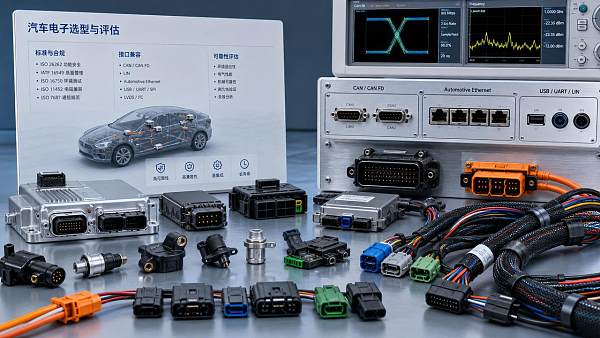
Physical interfaces come first. Connector type, pin definition, sealing grade, current capacity, and cable routing constraints affect packaging and serviceability.
Then comes communication compatibility. CAN, CAN FD, LIN, FlexRay, Automotive Ethernet, UART, SPI, and LVDS all carry different implications for bandwidth, latency, diagnostics, and integration effort.
Power interface details matter just as much. Nominal voltage range, transient tolerance, inrush current, wake-up behavior, and sleep current directly influence system stability.
In actual programs, interface review should include both the nominal design case and edge cases. Cold start, brownout, sensor fault states, gateway delays, and firmware version drift often expose the real integration burden.
- Check whether signal definitions align with the existing network matrix.
- Confirm diagnostic protocols and tool compatibility early.
- Review software interfaces, not only hardware pinouts.
- Validate connector sourcing and second-source availability.
Reliability is measured across the full lifecycle
Reliability in vehicle electronics is not limited to passing validation samples. It includes stable field performance over years of thermal cycling, vibration, contamination, power fluctuation, and software updates.
That is why a useful review combines design robustness with manufacturing consistency. Process capability, traceability, change control, and field return analysis deserve attention alongside laboratory test data.
Signals that deserve closer scrutiny
- Test reports show pass results but little margin detail.
- Firmware dependency on a narrow hardware revision window.
- Incomplete PCN and EOL management commitments.
- Limited failure analysis support for returned units.
- Unclear derating policy for heat, voltage, or load conditions.
More mature suppliers usually provide deeper evidence: accelerated life testing logic, FIT or failure trend assumptions, production screening methods, and corrective action responsiveness.
From an industry intelligence perspective, this is where technical review connects with supplier resilience. A stable design is valuable, but a stable support model is equally important.
Typical application contexts shape the right choice
Different vehicle electronics priorities appear across use cases. Passenger vehicles may emphasize user experience, compact packaging, and software update readiness.
Commercial vehicles often place heavier weight on uptime, diagnostic accessibility, thermal endurance, and field repair practicality.
Electrified platforms add another layer. Battery systems, power conversion, insulation monitoring, and charging interfaces raise the consequence of interface errors and thermal weakness.
Connected mobility applications create stronger demands for data security, remote update capability, and network coexistence. In those cases, vehicle electronics selection should include backend and service architecture considerations.
A practical decision framework for comparing options
A balanced comparison usually works better than a single-score ranking. The strongest option on paper may not be the best fit for the target architecture or launch schedule.
One useful method is to score candidate vehicle electronics across technical fit, compliance maturity, reliability evidence, supply continuity, serviceability, and total lifecycle cost.
What to do next when narrowing a shortlist
Start by defining the operational envelope clearly. Temperature range, voltage events, data throughput, vibration exposure, cybersecurity level, and service expectations should be written before vendor comparison begins.
Then test claims against evidence. Ask for interface documentation, environmental reports, software maintenance policy, and change notification rules.
It also helps to separate must-have requirements from optimization targets. This prevents attractive but low-priority features from distorting the decision.
For organizations tracking cross-border sourcing and technology shifts, the most reliable decisions come from combining component-level verification with wider market intelligence. That is where the GIIH approach becomes practical: technical standards, supplier behavior, and industry direction should be read together, not in isolation.
A disciplined shortlist for vehicle electronics should therefore end with three outputs: a validated interface map, a standards compliance checklist tied to application risk, and a lifecycle reliability view that includes service and supply continuity. With those in place, the next evaluation step becomes clearer, faster, and far more defensible.
Recommended News
 Sep 12, 2026What does UN 38.3 testing cover for EV battery shipments?EV battery UN 38.3 testing covers altitude, thermal, vibration, shock, short-circuit, overcharge, and discharge risks. Learn key compliance steps for safer EV battery shipments.
 Aug 24, 2026How to compare electric drive components for torque and efficiencyElectric drive components comparison starts with real load profiles. Learn how to evaluate torque, efficiency, motor-inverter-gearbox fit, and avoid costly selection mistakes.
 Jul 29, 2026400V EV Battery Components Explained: Key Parts, Functions, and System Design BasicsEV battery components 400V explained clearly: discover key parts, core functions, safety logic, thermal design, and system basics to evaluate EV battery packs with confidence.
 Jul 18, 2026Automotive Component Rating Standards Explained: How to Compare Load, Temperature, and Safety LimitsAutomotive component rating standards explained clearly: learn how to compare load, temperature, and safety limits to reduce sourcing risk, improve compliance, and choose parts with confidence.
 Jul 15, 2026EV Components North America: Sourcing Priorities, Compliance, and Lead Time FactorsEV components North America buyers now face tougher sourcing decisions. Explore compliance risks, lead time pressures, and smarter strategies to reduce disruption and improve EV supply chain performance.
 Jul 13, 2026How to Evaluate a Battery Components Exporter for Quality, Traceability, and Lead TimeBattery components exporter selection goes beyond price. Learn how to assess quality control, traceability, and lead time to reduce supply risk and choose a reliable partner.
 Jul 12, 2026High Voltage EV Batteries vs Standard Packs: Key Design and Safety DifferencesHigh voltage EV batteries vs standard packs: explore the key design, charging, efficiency, and safety differences to choose the right EV battery architecture with confidence.
![]() Jul 07, 2026EV Accessories Buying Guide: Which Add-Ons Matter for Safety, Charging, and Daily Use?EV accessories buying guide: discover which add-ons truly improve charging, safety, and daily convenience, so you can choose smarter, safer gear with confidence.
Jul 07, 2026EV Accessories Buying Guide: Which Add-Ons Matter for Safety, Charging, and Daily Use?EV accessories buying guide: discover which add-ons truly improve charging, safety, and daily convenience, so you can choose smarter, safer gear with confidence. Jun 30, 2026EV Motor Selection Guide: Torque, Efficiency, Cooling, and Cost Trade-OffsEV motor selection guide covering torque, efficiency, cooling, and cost trade-offs. Learn how to choose the right EV motor for better range, reliability, and total value.
 Jun 29, 2026Permanent Magnet EV Motor Selection: Torque, Efficiency, Cooling, and Cost Trade-OffsPermanent magnet EV motor selection explained: compare torque, efficiency, cooling, and total cost trade-offs to choose the right EV drive solution with confidence.
 Jun 27, 2026Sourcing Guide for EV Components: How to Compare Suppliers, Lead Times, and MOQSourcing guide EV components for procurement teams: compare suppliers, lead times, MOQ, quality, and total cost to reduce risk and make smarter EV sourcing decisions.
 Jun 27, 2026Electric Drive Components Price in Europe: What Drives Cost by Motor, Inverter, and VolumeElectric drive components price Europe explained: see how motor design, inverter technology, and order volume shape real costs in Europe, and compare suppliers with greater confidence.
 Jun 25, 2026How Long Life Mobility Components Reduce Maintenance in High-Use EquipmentLong life mobility components cut maintenance by matching real load, floor, and cleaning conditions. See how smarter selection improves uptime, lowers service costs, and extends equipment life.
 Jun 23, 2026Spark Plugs OEM Sourcing Guide: Key Specs, Compatibility Checks, and Supplier RisksSpark plugs OEM sourcing guide covering key specs, compatibility checks, total cost, and supplier risks—learn how to avoid fitment errors, returns, and costly quality issues.
 Jun 13, 2026Vehicle Electronics Selection Guide: Key Standards, Interfaces, and Reliability FactorsVehicle electronics selection starts with standards, interfaces, and reliability. Learn how to compare components, reduce integration risk, and choose smarter for long-term performance.
 Jun 06, 2026What Is a BMS in Battery Systems? Functions, Key Components, and Selection BasicsBMS explained: learn what a Battery Management System does, its key components, and how to choose the right BMS for safer, longer-lasting, better-integrated battery systems.
 Jun 02, 2026Solid-State Battery Breakthroughs: What to Verify Before EV AdoptionSolid-state battery breakthroughs are reshaping EV strategy—learn what to verify in energy density, cycle life, safety, cost, and supplier readiness before adoption.
 May 31, 2026Why is EV battery tech reshaping range expectations?EV battery tech is redefining real-world range through smarter chemistry, thermal control, fast charging, and software—discover what matters beyond mileage.
![]() May 19, 2026Why long-lifespan solid-state batteries matter nowSolid-state battery breakthroughs long lifespan are reshaping EVs, grid storage, and industry. Discover why longer life, safer performance, and lower total cost matter now.
May 19, 2026Why long-lifespan solid-state batteries matter nowSolid-state battery breakthroughs long lifespan are reshaping EVs, grid storage, and industry. Discover why longer life, safer performance, and lower total cost matter now.![]() May 19, 2026Is off-grid lithium storage worth the upfront cost?Lithium battery storage for off-grid applications can justify higher upfront costs through lower maintenance, better efficiency, and stronger long-term ROI. See when it pays off.
May 19, 2026Is off-grid lithium storage worth the upfront cost?Lithium battery storage for off-grid applications can justify higher upfront costs through lower maintenance, better efficiency, and stronger long-term ROI. See when it pays off.![]() May 19, 2026Are solid-state battery breakthroughs finally lifting energy density?Solid-state battery breakthroughs in high energy density are moving beyond hype. Learn what technical evaluators should verify on cycle life, safety, cost, and scalable commercialization.
May 19, 2026Are solid-state battery breakthroughs finally lifting energy density?Solid-state battery breakthroughs in high energy density are moving beyond hype. Learn what technical evaluators should verify on cycle life, safety, cost, and scalable commercialization. May 18, 2026Why portable lithium battery storage needs better designLithium battery storage portable design matters more than ever. Discover how better safety, mobility, and charging design improve backup, travel, and field power performance.
 May 17, 2026What next-gen EV charging must solve beyond faster speedNext-gen wireless charging for electric vehicles must solve efficiency, safety, interoperability, and real-world deployment fit—not just speed. Explore what makes EV charging scalable and investment-ready.
 May 17, 2026How close are solid-state batteries to real EV production?Solid-state battery breakthroughs for electric vehicles are moving beyond the lab. Discover how close they are to real EV production, what still blocks scale-up, and which milestones matter most.