


Search News
Global Industrial Intelligence Hub (GIIH)Industry Portal
Global Industrial Intelligence Hub (GIIH)Status
Standard Access
Upgrade to PremiumNewsWaste Management Compliance: Key Standards, Tracking Methods, and Audit Risks
Time
Click Count
Why has waste management compliance become a frontline control issue?
Waste management compliance now affects far more than permits and disposal records.
It shapes production continuity, contractor oversight, audit outcomes, and environmental credibility across complex supply chains.
In practical terms, a weak waste program can stop shipments, trigger corrective actions, delay certifications, or expose hidden handling failures.
That is why waste management is increasingly reviewed alongside EHS controls, quality systems, and supplier governance.
For global operations, the challenge is not only legal compliance.
The harder part is keeping classification rules, storage practices, transport documents, and site routines aligned across regions.
This is also where industrial intelligence becomes useful.
GIIH often frames environmental controls as decision systems, not isolated paperwork, especially when rules shift across logistics, manufacturing, and sustainability priorities.
Which standards usually define waste management compliance in real operations?
There is rarely one universal rulebook.
Waste management compliance usually sits at the intersection of environmental law, transport regulation, site permits, and management system requirements.
A common mistake is assuming that disposal alone proves compliance.
Auditors usually look earlier in the chain, starting with waste identification and internal control.
What do auditors and regulators usually expect to see?
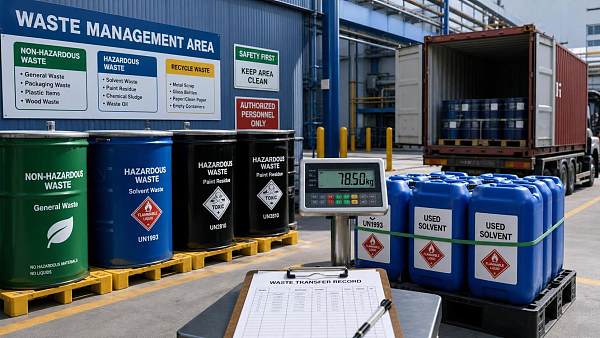
- A documented method for waste classification, including hazardous and non-hazardous separation.
- Container labels that match internal logs, storage areas, and shipping records.
- Defined accumulation limits, storage times, and emergency response controls.
- Approved transporters and disposal vendors with current licenses.
- Training evidence showing that operators follow the written procedure.
- Retention of manifests, transfer notes, weighbridge tickets, and exception reports.
Where a certified system exists, ISO 14001 often supports governance.
Still, certification does not replace local legal duties.
More common audit findings come from gaps between procedure and execution, not from missing policy statements.
How should waste be tracked if the goal is audit readiness, not just recordkeeping?
A strong waste management tracking method creates traceability from generation point to final treatment.
That sounds simple, but many systems break between production, warehouse, transporter, and finance records.
The more reliable approach is to track each waste stream by source, code, quantity, movement date, container status, and approved destination.
It also helps to connect environmental logs with purchasing and contractor controls.
That way, expired vendor licenses or unusual transport volumes become visible earlier.
In actual audits, consistency matters more than software complexity.
A basic register that reconciles quantities and dates can outperform a digital platform with poor field discipline.
Still, large multi-site businesses often benefit from shared dashboards.
That is especially true when waste management data also informs logistics planning, ESG reporting, or supplier risk reviews.
Where do companies usually fail, even when documents look complete?
This is one of the most searched questions for a reason.
Waste management compliance failures often hide in routine habits rather than formal systems.
For example, a site may have approved procedures but still store incompatible waste together during busy production periods.
Another common gap appears when contractors handle packing, relabeling, or loading without clear supervision.
High-frequency audit risks worth checking
- Waste codes copied forward from old records, even after process changes.
- Satellite accumulation points that exist physically but not in procedures.
- Transport documents prepared by vendors without internal verification.
- Spill kits, drainage protection, or fire controls missing near storage zones.
- Training completed once, then never refreshed after line changes.
- Recovered material counted as reusable stock without legal confirmation.
The pattern is clear.
Most issues come from broken interfaces between operations, maintenance, warehousing, and external handlers.
That is why cross-functional reviews often reveal more than a policy audit alone.
GIIH frequently highlights this systems view in environmental technology coverage, especially where waste data intersects with supply chain resilience.
What is the practical difference between legal compliance and a robust internal waste program?
Legal compliance asks whether minimum obligations are met.
A robust program asks whether failures can be detected early and corrected before they become reportable events.
That difference matters when operations span multiple countries or when customer audits extend beyond permit review.
A stronger internal system usually includes periodic waste mapping, exception thresholds, vendor scorecards, and root-cause review of recurring disposal anomalies.
It also treats waste management as a source of process intelligence.
Unexpected waste volume can signal material loss, unstable production, contamination, or poor segregation discipline.
That is why mature organizations compare waste trends against throughput, scrap, and maintenance events.
The result is not only better waste management compliance.
It is also better operational visibility.
If an audit is approaching, what should be reviewed first?
Start with what an auditor can verify immediately on the floor.
Visible conditions usually shape the rest of the inspection.
If labels, storage dates, and segregation controls are wrong, document quality will receive closer scrutiny.
A focused pre-audit review usually covers these points
- Confirm that every active waste stream has a current classification basis.
- Walk storage areas and compare physical labels with the register.
- Check accumulation dates, maximum holding periods, and container condition.
- Review the latest shipments for signature gaps or weight inconsistencies.
- Verify licenses, insurance, and treatment scope for all external waste vendors.
- Test whether site personnel can explain routine handling steps clearly.
A useful final step is sampling backward from one disposal record to the point of generation.
If that trail breaks, the waste management system is not fully defensible.
For global businesses, it also helps to compare local practices against regional rule changes and market trends.
That broader perspective is exactly where a platform such as GIIH adds value, by connecting regulatory signals with operating realities across sectors.
What should happen next if the current system feels compliant on paper but fragile in practice?
The next move is not to rewrite everything.
It is to identify where waste management control depends too heavily on memory, informal workarounds, or vendor assumptions.
Begin with a short gap review across classification, storage, transfer, and final disposal evidence.
Then rank issues by audit exposure and operational impact.
In many sites, the biggest improvement comes from tighter traceability and clearer ownership, not from adding more forms.
Waste management compliance works best when procedures, site behavior, and external records tell the same story.
If that alignment is missing, now is the right time to map waste streams, validate vendors, refresh training, and build review triggers before the next inspection window opens.
A disciplined system does more than reduce violations.
It protects continuity, supports environmental accountability, and strengthens decision-making across the wider industrial chain.
Recommended News
 Sep 08, 2026When do recycling solutions reduce waste disposal costs for businesses?Recycling solutions can lower business waste costs when diversion, efficient collections, and compliance savings exceed implementation expenses. Discover how to build a stronger ROI case.
 Jul 13, 2026How to Compare a Recycling Solutions Manufacturer for Waste Stream Fit and Operating CostRecycling solutions manufacturer comparison starts with waste stream fit and operating cost. Learn how to evaluate energy, maintenance, uptime, and service for smarter recycling investments.
 Jul 12, 2026What Are Garbagesortingplants Used for in Modern Waste Management Systems?garbagesortingplants help recover valuable materials, cut landfill use, and improve recycling efficiency. Discover how they support smarter, cleaner modern waste management.
 Jul 05, 2026How AI Waste Recycling Systems Work in MRFs: Sorting Accuracy, Sensors, and ROIAI waste recycling systems in MRFs use sensors, machine vision, and automation to boost sorting accuracy, cut contamination, and improve ROI. See how they work.
 Jul 03, 2026Waste Management Systems in Southeast Asia: Key Market Drivers and Buyer PrioritiesWaste management systems Southeast Asia are being reshaped by regulation, ESG pressure, and resource recovery demand. Explore key market drivers and buyer priorities to identify smarter, scalable opportunities.
 Jul 01, 2026How to Evaluate Waste Recycling Systems in North America for Multi-Site OperationsWaste recycling systems North America for multi-site operations: learn how to compare vendors, control lifecycle costs, strengthen compliance, and scale smarter recycling decisions.
 Jun 28, 2026Outdoor Garden Supplies for Commercial Landscaping: What to Buy for Durability and Low UpkeepOutdoor garden supplies for commercial landscaping: discover what to buy for durability, low upkeep, smarter sourcing, and long-term value across demanding commercial sites.
 Jun 27, 2026What Does a Waste Treatment Plant Do? Key Processes, Equipment, and Output StandardsWaste treatment plant guide: learn key processes, core equipment, output standards, and how modern facilities recover value, reduce risk, and meet strict compliance requirements.
 Jun 24, 2026Biomass Energy Project Evaluation: Feedstock Costs, ROI, and Operational Risks ExplainedBiomass energy project evaluation starts with feedstock costs, ROI sensitivity, and operational risk. Learn how to spot weak assumptions, compare options, and make smarter investment decisions.
 Jun 20, 2026Eco-Friendly Innovations in Manufacturing: Which Solutions Are Practical to Adopt First?Eco-friendly innovations in manufacturing: discover the most practical solutions to cut waste, lower energy costs, strengthen compliance, and improve resilience without disrupting production.
 Jun 17, 2026Waste Management Compliance: Key Standards, Tracking Methods, and Audit RisksWaste management compliance explained: learn key standards, tracking methods, and top audit risks to strengthen control, avoid costly gaps, and improve operational resilience.
 Jun 12, 2026Eco Tech in Waste Management: Which Solutions Improve Sorting and Energy Efficiency?Eco Tech in waste management: discover which solutions improve sorting accuracy and energy efficiency across mixed, organic, and industrial waste streams for smarter, higher-value recovery.
 Jun 07, 2026Sustainable Waste Disposal Methods: How to Choose the Right Option for Business OperationsSustainable waste disposal starts with the right fit. Learn how businesses can compare methods, cut risk, stay compliant, and choose cost-effective options that support ESG goals.
 May 31, 2026Is Sustainable Board ready for high-volume packaging?Sustainable Board can scale high-volume packaging when performance, compliance, supply, and recovery are validated by real scenarios. Learn how to reduce risk and improve ROI.
 May 30, 2026Can recycled materials meet strict quality standards?Recycled materials can meet strict quality standards with traceability, testing, and supplier control. Learn how to reduce risk, prove compliance, and build sustainable value.
![]() May 23, 2026How to choose garden supplies for commercial landscapingOutdoor garden supplies for commercial landscaping: learn how to compare durability, supplier reliability, lifecycle cost, and compliance to make smarter, lower-risk purchasing decisions.
May 23, 2026How to choose garden supplies for commercial landscapingOutdoor garden supplies for commercial landscaping: learn how to compare durability, supplier reliability, lifecycle cost, and compliance to make smarter, lower-risk purchasing decisions. Apr 30, 2026Recycling solutions that struggle with inconsistent waste streamsDiscover recycling solutions for inconsistent waste streams with sustainable waste disposal, environmental innovation, Eco Tech, and green energy strategies that improve recovery and ROI.
 Apr 29, 2026Eco Tech monitoring tools that catch waste leaks earlierEco Tech monitoring tools detect waste leaks earlier, improving sustainable waste disposal, recycling solutions, and environmental innovation with eco-friendly solutions that cut risk and cost.
 Apr 25, 2026Eco Tech tools helping waste audits become more accurateEco Tech improves sustainable waste disposal and recycling solutions with environmental innovation and sustainable technology, helping businesses cut costs, boost compliance, and scale eco-friendly solutions.
 Apr 22, 2026Recycling solutions facing stricter material traceability rulesRecycling solutions for stricter traceability: discover sustainable waste disposal, Eco Tech, and sustainable technology that reduce compliance risk and unlock greener growth.
 Apr 22, 2026Are closed-loop recycling solutions worth the extra setup?Sustainable waste disposal and recycling solutions: find out when closed-loop systems pay off through environmental innovation, eco-friendly solutions, and stronger supply value.
 Apr 22, 2026What makes recycling solutions scalable across multiple sitesDiscover how recycling solutions scale across multiple sites through sustainable waste disposal, environmental innovation, Eco Tech data visibility, and eco-friendly solutions that also support replacement parts and vehicle upgrades.
 Apr 22, 2026Recycling solutions for materials that are hard to sortExplore recycling solutions for hard-to-sort materials, from sustainable waste disposal and environmental innovation to eco-friendly solutions, green energy, and sustainable technology trends.
 Apr 22, 2026How to compare recycling solutions beyond recovery ratesCompare recycling solutions beyond recovery rates with a practical guide to sustainable waste disposal, environmental innovation, eco-friendly solutions, and sustainable technology for smarter, lower-risk decisions.