


Search News
Global Industrial Intelligence Hub (GIIH)Industry Portal
Global Industrial Intelligence Hub (GIIH)Status
Standard Access
Upgrade to PremiumNewsWhen does energy efficient lighting pay back its higher upfront cost?
Time
Click Count
When Does Energy Efficient Lighting Pay Back Its Higher Upfront Cost?
For financial approvers, the question is not whether energy efficient lighting saves power, but when its higher upfront cost turns into measurable value. Payback depends on electricity rates, operating hours, maintenance reductions, available incentives, and the lifespan of the installation. A lighting proposal that looks compelling in a high-use warehouse may be far less attractive in a lightly occupied office. The useful decision is therefore not “LED or not?” but “what cash flow, risk reduction, and operating benefit does this specific upgrade produce?”
In many commercial and industrial settings, energy efficient lighting pays back when fixtures operate long enough each year for lower wattage and fewer replacements to outweigh the installed cost. That can happen relatively quickly in 24-hour logistics facilities, manufacturing areas, parking structures, retail sites with extended opening hours, and healthcare environments. It may take longer in meeting rooms, seasonal buildings, or spaces already fitted with relatively efficient lamps. The calculation is simple in principle, but a reliable approval decision requires more discipline than comparing fixture prices.
Payback starts with the right definition of cost
The purchase price of a fixture is only one part of the investment. A complete project cost should include luminaires, drivers, controls, mounting hardware, electrical work, access equipment, commissioning, design support where needed, disposal of removed equipment, and any disruption to operations. For a site with high ceilings or controlled production areas, labor and access can materially change the economics. A low-cost fixture that requires frequent replacement may also create a larger long-term burden than its invoice price suggests.
The basic simple-payback calculation is:
Simple payback period = Net installed project cost ÷ Annual savings
Annual savings should include more than electricity. At a minimum, the model should separate energy savings, avoided maintenance cost, incentive value if it is reasonably obtainable, and any additional operational cost created by the project. A retrofit that lowers energy use but demands new software subscriptions, specialist servicing, or repeated commissioning should not hide those expenses inside an optimistic business case.
For a first pass, annual energy savings can be estimated with the following expression:
(Existing connected load − Proposed connected load) × Annual operating hours × Electricity tariff
The calculation needs consistent units. If load is measured in kilowatts, operating hours in hours per year, and the tariff in cost per kilowatt-hour, the result is annual energy cost savings. It is a transparent starting point—not a final investment memo.
The five variables that usually decide the outcome
Operating hours tend to be the strongest driver. Replacing older lighting in an area used continuously creates savings every hour of every day. By contrast, a low-occupancy space may not justify a full fixture replacement unless the existing equipment is unreliable, difficult to maintain, or unsuitable for the required light level. Before accepting an annual-hours assumption, finance teams should ask where it came from: building-management data, production schedules, occupancy patterns, or simply a broad estimate.
Electricity price matters just as much. A global organization may use one corporate hurdle rate but operate sites with sharply different tariffs, demand charges, taxes, and procurement arrangements. The same technical package can therefore have a very different payback in two regions. For multi-site programmes, local tariff verification should be part of the site survey rather than an afterthought.
The baseline is another common source of error. Do not compare a proposed LED fixture with the wattage printed on an old lamp alone. Existing systems may have ballast losses, multiple lamps per fixture, degraded controls, or different operating schedules. Conversely, a replacement system may include emergency functions, sensors, wireless nodes, or higher output that changes connected load. The comparison must reflect the actual system, not a simplified catalogue-to-catalogue match.
Maintenance savings can make a marginal project viable, especially where relamping requires lifts, shutdowns, permits, specialist access, or work in hazardous locations. Yet this line item should be treated carefully. It should reflect the site’s real replacement process: labor time, access cost, spare-part cost, safety procedures, and the expected failure behavior of both systems. Avoid claiming that maintenance will disappear. It will not. Drivers, sensors, connectors, controls, and physical fixtures can all require attention over time.
Finally, incentives can improve payback, but they should not be assumed until eligibility is confirmed. Utility programmes, local efficiency schemes, tax treatment, and grant conditions vary by market and can change. Some require pre-approval, specific equipment documentation, or post-installation verification. If the project only meets an internal return threshold after an incentive, approval should be conditional on securing it.
Why simple payback is necessary but not sufficient
Simple payback is popular because it is understandable. It answers a practical question: how long will it take to recover the cash invested? But it ignores the time value of money, the remaining value of the installation after payback, future maintenance exposure, and the difference between a two-year and four-year project if each asset has a different expected service life.
For capital approvals, it is usually better to review simple payback alongside net present value (NPV), internal rate of return (IRR), and total cost of ownership (TCO). NPV discounts future savings and costs to today’s value. IRR indicates the implied return on the investment. TCO considers the full expenditure over the relevant asset life. None is a substitute for operational judgment, but together they prevent a short payback from being mistaken for a complete investment case.
A practical approval paper can show all three without becoming overly technical. It should also identify which assumptions are known, which are estimated, and which still need supplier or site validation. This makes later variance analysis much easier.
Controls can improve returns—or dilute them
Occupancy sensors, daylight harvesting, scheduling, dimming, and networked controls can reduce lighting hours beyond the fixture-level savings. They are often valuable in corridors, warehouses with uneven traffic, offices with daylight access, and shared spaces. But controls are not automatically a financial win. Their added capital cost, installation complexity, interoperability requirements, cybersecurity considerations, commissioning time, and user acceptance need to be included.
A useful distinction is between savings that come from lower wattage and savings that depend on behavior or programming. Fixture efficiency is relatively straightforward to model. Control savings depend on actual occupancy, sensor placement, settings, overrides, and ongoing management. It is prudent to model these separately. A conservative base case can use verified fixture savings, while a second scenario shows the potential benefit from well-commissioned controls.
Light quality also belongs in the financial discussion. Poor glare control, inadequate vertical illumination, inappropriate color rendering, flicker concerns, or badly designed sensor behavior can affect safety, inspection work, worker comfort, and process reliability. A project should meet the lighting needs of the task, not merely minimize watts. Any required illuminance levels, emergency-lighting obligations, and local electrical or building requirements must be checked against the relevant site and jurisdiction.
A more credible approval model uses scenarios
The most reliable lighting business cases do not rely on a single perfect forecast. They test the decision against plausible changes in the inputs. A conservative scenario may assume lower operating hours, no incentive, and only clearly evidenced maintenance savings. A base case can use the site’s validated schedule and confirmed commercial terms. An upside case may include control savings or electricity-price escalation, but these should be visible rather than embedded quietly in the base model.
This approach is particularly useful when deciding between a phased retrofit and a full-site replacement. A phased programme lowers near-term capital demand and creates an opportunity to validate energy, maintenance, and light-quality assumptions. However, it may increase mobilization costs, extend disruption, and limit volume purchasing leverage. A full rollout can capture scale benefits, but it demands stronger surveying, supplier due diligence, and installation planning before funds are committed.
Procurement should also evaluate warranty terms beyond their headline duration. Clarify what is covered, who pays for labor and access, how failures are handled, what documentation is required, whether replacements are equivalent or merely available, and how long critical components will remain obtainable. For global estates, verify regional voltage compatibility, local approvals, lead times, import exposure, and the ability to support the same product family across markets. These details influence risk more than a small difference in unit price.
Common reasons lighting payback models disappoint
Many projects underperform on paper before they underperform in the field. The recurring causes are familiar: operating hours are overstated; existing loads are not measured; utility tariffs are incomplete; installation costs omit access or after-hours work; controls are assumed to save energy without a commissioning plan; and maintenance savings are counted without considering the actual replacement history.
Another issue is treating every room as the same investment. High-bay production areas, cold storage, clean environments, exterior yards, offices, and parking facilities have different duty cycles and failure consequences. The highest-return assets are not always the oldest fixtures. They are often the fixtures with the longest hours, the greatest maintenance burden, or the highest cost of a lighting failure.
Measurement after installation is equally important. Retain pre-project bills, document baseline operating conditions, record installed equipment, and compare post-installation consumption over an appropriate period. Changes in production volume, occupancy, weather, or building use can distort comparisons, so results should be interpreted rather than simply read from one bill to the next.
Making the decision with industrial context
Energy efficient lighting is usually easiest to approve where the operational case and the financial case reinforce each other: long hours, high electricity cost, difficult maintenance access, aging equipment, and a clear need for better light or more dependable control. It is less compelling where annual usage is low, existing systems are relatively new, or the project requires extensive electrical alteration without a corresponding operational benefit.
This is why industrial decisions need connected information rather than isolated product claims. GIIH examines intelligent lighting within the broader smart-living, logistics, manufacturing, and environmental-technology landscape: energy costs, supply-chain resilience, technical specifications, maintenance realities, and regional market conditions all affect the result. Turning fragmented inputs into a decision-ready model is often more valuable than obtaining another generic savings estimate.
Before approving a project, request a site-specific load inventory, operating-hour basis, tariff assumption, installation scope, maintenance methodology, control strategy, warranty responsibilities, and sensitivity analysis. If those items withstand scrutiny, the payback period becomes more than a persuasive number. It becomes a usable forecast for capital planning, procurement oversight, and long-term facility management.
Recommended News
 Sep 25, 2026When does energy efficient lighting pay back its higher upfront cost?Energy efficient lighting payback explained: assess energy savings, maintenance, tariffs, incentives, controls, and ROI to build a confident investment case.
 Sep 22, 2026How energy saving lighting for offices can cut operating costsEnergy saving lighting for offices cuts operating costs through efficient LEDs, smart controls, realistic payback analysis, and lower maintenance needs. Explore practical upgrade strategies.
 Sep 04, 2026Are Energy-Efficient Lighting Rebates Available for Industrial Facilities?Are energy efficient lighting rebates available for industrial facilities? Explore eligibility, pre-approval, LED upgrades, controls, and cost-saving incentive tips.
 Aug 21, 2026Do LED lights with low power consumption really cut electricity costsLED lights low power consumption can lower electricity bills, but real savings depend on brightness, usage hours, and quality. Learn how to choose LEDs that cut costs and last longer.
 Jul 20, 2026How Much Does Energy Efficient Lighting Cost and When Does It Pay Off?Energy efficient lighting cost is more than fixture price. Learn what drives payback, hidden lifecycle costs, and when LED upgrades deliver the strongest return.
 Jul 19, 2026How to Choose LED Lights for Cold Storage: Temperature, IP Rating, and EfficiencyLED lights for cold storage: learn how to choose the right fixtures by comparing temperature tolerance, IP rating, visibility, and efficiency for safer, longer-lasting performance.
 Jul 10, 2026Lighting Cost Breakdown: Equipment, Installation, Energy Use, and MaintenanceLighting cost explained from equipment and installation to energy use and maintenance. Compare total ownership factors, avoid hidden expenses, and make smarter buying decisions.
 Jul 08, 2026Custom Lighting for Commercial Projects: How to Specify Output, Beam Angle, and ControlsLighting custom for commercial projects made practical: learn how to specify output, beam angle, and controls to improve performance, reduce risk, and make smarter buying decisions.
 Jul 06, 2026LED Lights Wholesale: How to Check MOQ, Warranty Terms, and Price BreaksLED lights wholesale made simple: learn how to verify MOQ, warranty terms, and price breaks to reduce sourcing risk, protect margins, and choose suppliers with confidence.
 Jul 06, 2026Intelligent Lighting for Factories: Which Control Features Improve Safety and Efficiency?Intelligent lighting for factories improves safety, cuts energy waste, and supports smoother workflows with motion sensing, zoning, daylight control, and emergency-ready features.
 Jul 04, 2026Smart Living for Smart Lighting: Which Controls and Sensors Fit Each Room?Smart living for smart lighting made simple: discover the best controls and sensors for every room to improve comfort, safety, and energy savings with smarter home planning.
 Jul 03, 2026UL Listed Lighting System Requirements: What to Check for Commercial ProjectsUL listed lighting system checks can make or break commercial approvals. Learn what to verify in listings, controls, ratings, and documents to avoid delays and compliance risk.
 Jul 02, 2026LED Lights Lumen Output Explained: How to Compare Brightness Across FixturesLED lights lumen output explained in a clear, practical guide. Learn how to compare fixture brightness, beam spread, efficiency, and color temperature before you buy.
 Jul 01, 2026Commercial LED Lighting in the Middle East: What to Check Before SpecificationCommercial LED lighting Middle East projects need more than price checks. Learn how to verify heat, dust, power, optics, compliance, and maintenance before specification.
 Jun 29, 2026Industrial Lighting Selection Guide: Beam Angle, IP Rating, and Energy Use by Facility TypeIndustrial lighting guide for smarter facility upgrades: compare beam angle, IP rating, and energy use by warehouse, manufacturing, washdown, and outdoor site needs.
 Jun 23, 2026UV Nail Lamps Explained: Wattage, Timer, and Gel Compatibility Before You BuyUVnaillamps explained: compare wattage, timer settings, and gel compatibility to avoid curing issues, choose the right lamp faster, and get smoother, longer-lasting gel manicure results.
 Jun 22, 2026Why LED Lights with Low Heat Emission Work Better for Display Cases and Tight SpacesLED lights low heat emission solutions help display cases and tight spaces stay cooler, safer, and more visually stable. Discover why they improve protection, performance, and long-term efficiency.
 Jun 21, 2026Lighting Technology Analysis for Commercial Spaces: Efficacy, CRI, and Control CompatibilityLighting technology analysis for commercial spaces: compare efficacy, CRI, and control compatibility to cut costs, improve visual quality, and choose smarter future-ready lighting systems.
 Jun 19, 2026Lighting Sourcing Checklist: How to Compare Suppliers, Certifications, and MOQLighting sourcing made simple: compare suppliers, certifications, MOQ, lead times, and quality risks before choosing a quote. Use this checklist to source smarter and avoid costly mistakes.
 Jun 15, 2026How to Use Lighting in Small Rooms: Placement Tips, Layering, and Common MistakesHow to use lighting in small rooms: discover smart placement, layered lighting ideas, bulb tips, and common mistakes to avoid for a brighter, bigger-feeling space.
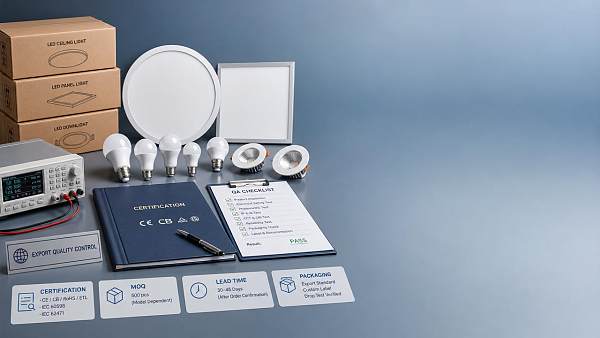
 Jun 05, 2026How to Evaluate a Lighting Exporter: Certifications, MOQ, Lead Time, and QA ChecklistLighting exporter evaluation starts with certifications, MOQ, lead time, and QA. Use this practical checklist to reduce sourcing risk, protect margins, and choose reliable partners.
![]() May 23, 2026Smart street lighting now matters beyond energy savingsSmart street lighting for urban areas now goes beyond energy savings—improving safety, maintenance efficiency, and smart city readiness. Discover the long-term ROI and strategic value.
May 23, 2026Smart street lighting now matters beyond energy savingsSmart street lighting for urban areas now goes beyond energy savings—improving safety, maintenance efficiency, and smart city readiness. Discover the long-term ROI and strategic value. May 22, 2026Do smart street lights cut energy costs enough to matter?Smart street lighting energy-saving solutions cut power and maintenance costs through LEDs, dimming, and remote monitoring. See when the savings are material enough to justify investment.
 May 21, 2026Are smart street lights really the lower cost optionSmart street lighting cost-effective solutions can cut energy and maintenance costs, but only in the right projects. See when smart street lights deliver true lifecycle savings.