


Search News
Global Industrial Intelligence Hub (GIIH)Industry Portal
Global Industrial Intelligence Hub (GIIH)Status
Standard Access
Upgrade to PremiumNewsHow Brake Drum Material and Machining Affect Semi Trailer Service Life
Time
Click Count
A brake drum can look serviceable long after its most important properties have begun to deteriorate. On a semi trailer, the drum must absorb repeated heat cycles, retain a stable friction surface, support even shoe contact, and remain dimensionally sound under load. When its material quality or machining is inconsistent, the first signs may be subtle: longer adjustment intervals, uneven lining wear, vibration during braking, or heat discoloration concentrated in one area. Left unaddressed, those conditions can shorten the working life of the drum, brake shoes, bearings, and related axle components.
For fleet teams, maintenance planners, and parts buyers, brake drum selection is not simply a question of finding a component that fits the hub and brake system. Material composition, casting integrity, machining accuracy, and inspection discipline all affect how reliably the braking assembly behaves over time. The impact becomes more pronounced on trailers operating at high gross weights, on mountainous routes, in stop-and-go distribution work, or in environments where moisture, road salt, and corrosive residues accelerate external deterioration.
Why brake drum condition has a wider service-life effect
A drum brake works by converting vehicle kinetic energy into heat. When the brake shoes expand against the inner drum surface, friction slows the rotating assembly. The drum must then distribute and release that heat without excessive distortion. If it cannot, the braking surface may develop hot spots, cracks, uneven wear patterns, or changes in hardness that alter friction behavior.
These problems do not remain isolated to the drum. A distorted or rough braking surface can cause shoes to contact unevenly, forcing parts of the lining to carry more load than others. Brake adjustment may become less stable, and drivers may notice pulling, pulsation, or reduced braking consistency. In severe cases, overheating can affect adjacent hub and bearing areas, particularly where the trailer continues operating after repeated brake drag or prolonged downhill braking.
The practical service-life question is therefore broader than “How long will the drum last?” A more useful question is whether the drum maintains its intended geometry and thermal behavior long enough to protect the surrounding brake assembly from accelerated wear.
Material quality determines how a drum handles heat and stress
Most heavy-duty brake drums are cast components because cast iron can provide useful thermal mass, wear resistance, damping characteristics, and manufacturability. Yet not all castings perform the same way. The chemistry of the iron, graphite structure, cooling rate during casting, and control of impurities influence how the finished drum responds to heat and mechanical stress.
Thermal capacity and resistance to distortion
A brake drum needs enough mass and suitable material properties to absorb heat during braking events without rapidly reaching temperatures that compromise the friction surface. A drum with insufficient thermal capacity for its intended axle load and duty cycle may heat quickly, especially when combined with frequent braking or sustained descents.
Heat alone is not always the issue. Uneven heating is often more damaging. If one portion of the drum expands more than another, temporary distortion can reduce the uniformity of shoe contact. Repeated cycles may leave permanent changes in shape. A drum that is no longer sufficiently round can create pulsation, localized lining wear, and repeated high-temperature zones.
Material consistency also affects resistance to thermal cracking. Cracks commonly originate where stress is concentrated, including around abrupt geometry changes, casting irregularities, or areas exposed to repeated high heat. Surface checking should be evaluated carefully during inspection because not every visible mark has the same significance. However, cracks that propagate, extend toward structural areas, or accompany noticeable heat damage require a more conservative response than ordinary surface discoloration.
Hardness balance and friction-surface wear
Hardness must be considered as a balance rather than an isolated quality marker. A drum that is too soft may wear quickly and lose dimensional integrity. A surface that is excessively hard or irregular, however, can contribute to poor bedding-in, accelerated lining wear, or inconsistent friction response depending on the shoe material and operating temperature.
The mating relationship between drum and lining matters. Brake linings are designed to work within a temperature range and with a reasonably stable counterface. When a drum surface becomes glazed, deeply scored, or affected by hard spots, the lining may no longer make even contact. Drivers may compensate by applying more brake pressure, while technicians may see recurring complaints despite replacing shoes or adjusting the brake mechanism.
Hard spots deserve particular attention because they can result in nonuniform machining response and uneven wear. During operation, they may leave high areas that create periodic contact patterns. The result can resemble other faults, such as a loose wheel-end component or incorrect adjustment, which is why diagnosis should include both brake inspection and wheel-end checks.

Machining accuracy is as important as casting quality
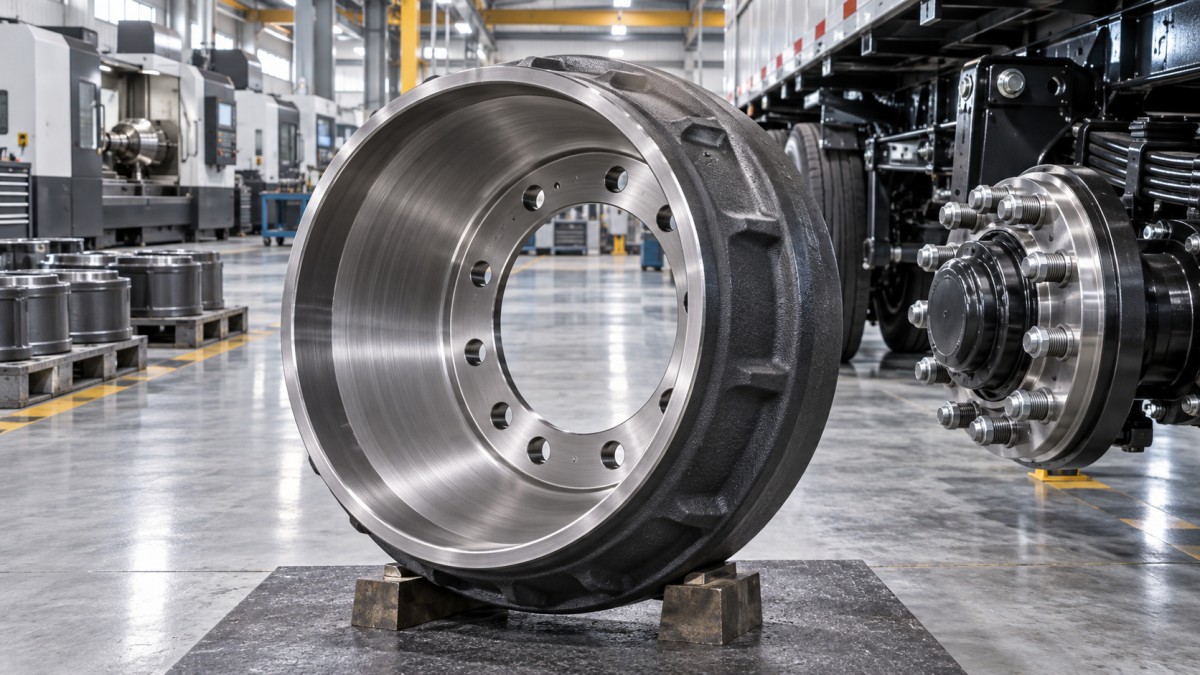
A well-designed material cannot compensate for poor machining. The inner diameter, roundness, concentricity, surface finish, mounting face, and balance of the drum all influence how it runs on the hub and how the brake shoes engage. Machining is where a casting becomes a functional braking component, and variation at this stage can undermine otherwise acceptable raw material.
The internal friction surface needs a finish that supports controlled bedding-in without being excessively rough or polished. An overly coarse surface can consume lining material rapidly and generate excessive heat during the early operating period. A surface that is too smooth may delay bedding or contribute to glazing under certain conditions. The appropriate finish depends on the brake design and lining specification, so a visual check alone is not a complete assessment.
Roundness and concentricity are equally important. If the drum bore is not centered properly relative to its mounting features, the shoes can engage more heavily once per revolution. This creates a repeating heat pattern and may be felt as brake pulsation. Over time, the uneven loading can enlarge the problem, particularly when the trailer operates with high brake demand.
Machining must also preserve sufficient usable wall thickness. Re-machining a worn drum may appear economical, but removing material reduces thermal mass and changes the drum’s ability to resist distortion. A drum should never be turned beyond the manufacturer’s stated service limit. If the remaining thickness is uncertain, or if cracks, severe heat checking, or structural damage are present, re-machining can create more risk than value.
Recognizing patterns that point to drum-related problems
Brake faults often have overlapping symptoms. A careful inspection sequence helps distinguish a drum issue from adjustment, air-system, shoe, hub, or bearing problems. Removing a drum without documenting the condition of the lining and wheel end can make diagnosis harder, since valuable evidence may be lost during disassembly.
Heat discoloration should never be interpreted in isolation. A drum may show evidence of occasional hard braking without being unserviceable, while a lightly discolored drum may still have serious distortion or cracking. Inspection should consider the complete pattern: lining condition, drum surface, dimensional measurements, adjustment history, and the operating conditions that led to the brake event.
Duty cycle changes what “good enough” means
A long-haul dry-freight trailer running mainly on level highways places different demands on drums than a tanker trailer making frequent stops or traveling on routes with steep gradients. Tank trailers introduce another consideration: the operating environment may involve corrosive vapors, wash-down chemicals, road spray, or residues associated with the cargo and cleaning process. These factors may not directly change the friction material inside the drum, but they can accelerate corrosion around mounting surfaces, studs, hubs, shields, and brake hardware.
Corrosion management is particularly relevant when fleets are working to prevent leaks and protect tank trailer integrity. Regular washing and inspection are necessary, yet trapped moisture or aggressive cleaning agents can remain around wheel-end areas if drainage and post-wash practices are poor. Corroded mounting faces can prevent a replacement drum from seating correctly. That can introduce runout even when the new component itself has been machined accurately.
For this reason, brake maintenance should be coordinated with wheel-end and corrosion-control routines. Before fitting a drum, technicians should clean the hub mounting face, check studs and nuts for damage, remove loose corrosion without altering critical surfaces, and confirm that the drum seats flush. Installation torque procedures should follow the vehicle or axle manufacturer’s requirements. An otherwise sound drum can develop avoidable stress if clamped unevenly or mounted over debris.
What procurement teams should verify before approving replacement drums
Replacement parts are often evaluated under time pressure, particularly when a trailer is immobilized or approaching a scheduled inspection. Fitment remains essential, but it should not be the only control point. Buyers managing semi trailer spare parts can reduce compatibility and early-life failure risk by confirming the axle and brake configuration, drum mounting arrangement, intended wheel size, and applicable dimensional limits before release.
When reviewing a BPW-compatible brake drum or comparable replacement component, the product information should be checked against the exact axle application rather than relying only on a broad trailer description. Differences in brake diameter, mounting pattern, drum depth, pilot arrangement, and allowable wear limits can affect whether a part is appropriate. A component that appears visually similar may not provide the correct running geometry.
For a useful reference point when assessing this category, semi trailer spare parts can be considered alongside the axle documentation, existing drum markings, and the vehicle manufacturer’s service requirements. The important procurement task is to verify the technical match and inspection evidence, not to assume that a nominally similar part will behave the same in service.
Quality documentation can also support better receiving inspection. Depending on the supplier and application, teams may request material traceability, dimensional inspection records, casting identification, or confirmation of the relevant part number. These documents do not replace physical checks, but they provide a clearer audit trail when multiple trailer types or axle configurations are maintained in the same fleet.
Receiving and installation checks that prevent avoidable failures
- Confirm that the part number and mounting configuration match the axle and brake assembly.
- Inspect the friction surface for shipping damage, rust pitting, machining marks, cracks, or debris.
- Check mounting faces and pilot areas for burrs, corrosion build-up, and damage that could prevent full seating.
- Measure relevant dimensions when required by the maintenance procedure, especially on mixed fleets or after repeated replacements.
- Inspect shoes, linings, rollers, cams, slack adjusters, and return components before assuming the drum was the sole cause of a braking complaint.
- Follow the specified bedding-in and adjustment procedure after installation, then recheck brake balance and temperature behavior during normal service.
Maintenance decisions should account for root cause, not just visible wear
Replacing a worn drum without investigating why it wore unevenly can lead to the same failure pattern on the next service interval. Brake drag, incorrect adjustment, contamination, overloaded axles, mismatched friction materials, and wheel-end runout can all shorten drum life. A maintenance record that captures the position of the removed drum, observed surface condition, lining wear pattern, and measured dimensions can reveal recurring axle-specific problems over time.
For fleets with demanding routes, periodic temperature comparison after a controlled stop can be a practical screening tool when used carefully. A significantly hotter wheel end may indicate a brake issue, but temperature alone cannot identify the exact cause. Ambient conditions, recent braking demand, load distribution, and bearing condition all affect the result. Any unusual pattern should lead to a focused mechanical inspection rather than an immediate assumption that the drum material is defective.
The most durable outcome comes from matching drum material and machining quality to the actual duty cycle, then protecting that component through correct installation, brake adjustment, corrosion control, and timely inspection. In semi trailer service, the drum is not simply a replaceable wear item. It is a heat-management and contact-control component whose condition influences the reliability of the entire braking system.
Recommended News
 Sep 22, 2026How Brake Drum Material and Machining Affect Semi Trailer Service LifeSemi trailer spare parts guide: discover how brake drum material and precision machining improve braking reliability, reduce wear, and extend trailer service life.
 Sep 10, 2026Evaluating Compatibility and Certification Requirements for Replacement Brake Drums on BPW-Axle Semi-TrailersDiscover certified semi trailer spare parts for BPW-axle trailers—ensuring brake drum compatibility, EN 15085-2 certification & optimal thermal performance.
 Sep 09, 2026When does shaft runout require custom precision parts?Custom precision parts shafts become essential when runout affects bearings, seals, vibration, or assembly accuracy. Learn how to specify reliable, high-performance shaft solutions.
 Jul 14, 2026RoHS Precision Parts Explained: Compliance Requirements, Test Reports, and Buying RisksRoHS precision parts explained: learn compliance requirements, how to read test reports, spot supplier gaps, and avoid costly buying risks before shipment approval.
 Jul 14, 2026Precision Machining Factory Selection Guide: Tolerances, Materials, and Inspection CapabilityPrecision machining factory selection starts with tolerance control, material expertise, and inspection capability. Learn how to compare suppliers, reduce risk, and choose with confidence.
 Jul 13, 2026Forged Engineered Components Explained: When Forging Outperforms Casting or MachiningForged engineered components deliver superior strength, fatigue resistance, and reliability. Discover when forging outperforms casting or machining for critical industrial parts.
 Jul 12, 2026Laminated Core Components: How to Choose Grades, Thickness, and ApplicationsLaminated core components explained: learn how to choose steel grades, thickness, and application fit to cut losses, improve efficiency, and make smarter design decisions.
 Jul 11, 2026Diamond Saw Blades for Stone, Tile, and Concrete: How to Choose the Right Typediamondsawblades buying guide for stone, tile, and concrete. Learn how to match blade type, cutting method, and machine for cleaner cuts, longer life, and fewer costly mistakes.
 Jul 09, 2026Product Selection Criteria for Stamped Parts: 7 Factors That Affect Fit and CostProduct selection criteria for stamped parts: discover 7 key factors that shape fit, tolerance, tooling, and total cost—make smarter sourcing decisions with less risk.
 Jul 09, 2026Sheet Metal Custom Parts: How to Choose Tolerances, Finishes, and Lead TimesSheet metal custom parts guide: learn how to choose the right tolerances, finishes, and lead times to reduce cost, improve fit, and avoid sourcing delays.
 Jul 08, 2026How to Do Product Category Analysis for Precision Parts Sourcing and Supplier ShortlistingProduct category analysis precision parts helps buyers classify components, compare true supplier fit, and shortlist faster with better cost, lead time, and compliance accuracy.
![]() Jul 07, 2026How to Evaluate a Battery Protection Parts Supplier for Quality, Testing, and Supply StabilityBattery protection parts supplier evaluation starts with quality, testing, and supply stability. Learn the key checks, red flags, and sourcing criteria for safer, more reliable decisions.
Jul 07, 2026How to Evaluate a Battery Protection Parts Supplier for Quality, Testing, and Supply StabilityBattery protection parts supplier evaluation starts with quality, testing, and supply stability. Learn the key checks, red flags, and sourcing criteria for safer, more reliable decisions. Jul 04, 2026Custom Precision Parts Prototype: Tolerance, Material, and Lead Time BasicsCustom precision parts prototype basics made practical: learn how tolerance, material, and lead time choices reduce risk, improve testing, and speed smarter production decisions.
 Jul 04, 2026Custom Engineered Components vs Standard Parts: When Is Customization Worth It?Custom engineered components vs standard parts: discover when customization lowers lifecycle cost, reduces downtime, and creates stronger competitive advantage.
 Jul 03, 2026How to Source Precision Machined Parts in the Middle East: Tolerances, Materials, and Supplier ChecksPrecision machined parts Middle East sourcing starts with tighter supplier checks. Learn how to compare tolerances, materials, certifications, and total cost for safer, smarter procurement.
 Jul 02, 2026Performance Factor Analysis for Surface Treatment: Key Variables That Affect Coating ResultsPerformance factor analysis for surface treatment reveals how substrate condition, cleanliness, profile, environment, and process settings shape coating results. Learn the key variables to improve adhesion, consistency, and production decisions.
 Jun 29, 2026Material Selection Analysis by Weight: When Lighter Parts Improve Total System PerformanceMaterial selection analysis by weight reveals when lighter parts truly improve total system performance, cutting energy, load, and lifecycle cost while avoiding hidden tradeoffs.
 Jun 27, 2026Engineered Components Drawing Review: 8 Checks to Catch Tolerance and DFM Issues EarlyEngineered components drawing review made practical: discover 8 smart checks to catch tolerance, GD&T, and DFM issues early, reduce rework, and improve launch readiness.
 Jun 26, 2026DIN Precision Parts: Tolerances, Materials, and How to Read Spec RequirementsDIN precision parts explained clearly: learn tolerances, material selection, surface requirements, and how to read DIN specs to reduce sourcing risk and choose suppliers with confidence.
 Jun 25, 2026Custom Precision Parts for Electronics: Tolerance, Material, and Process BasicsCustom precision parts electronics guide covering tolerance, material, and process basics. Learn how to reduce sourcing risk, improve fit and reliability, and choose suppliers with confidence.
 Jun 24, 2026Rapid Prototyping Near Me: How to Compare Lead Time, Materials, and Tolerance OptionsRapid prototyping near me: compare lead time, materials, and tolerance options with a practical framework to choose faster, smarter suppliers and reduce costly prototype delays.
 Jun 23, 2026Sheet Metal Components Manufacturing: Tolerance, Finish, and Process Options ExplainedSheet metal components manufacturing explained: compare tolerance, finish, and process options to reduce sourcing risk, control cost, and choose suppliers with confidence.
 Jun 23, 2026Ballscrews Selection Guide: How Lead, Accuracy, and Load Affect Motion PerformanceBallscrews selection guide covering lead, accuracy, and load. Learn how to improve speed, repeatability, and service life with practical tips for better motion performance.
 Jun 22, 2026PCB Assembly Process Explained: SMT, THT, Testing, and Common Defects to Watch ForPCB assembly explained clearly: learn SMT, THT, testing methods, and common defects that affect reliability, compliance, and product performance across industries.