


Search News
Global Industrial Intelligence Hub (GIIH)Industry Portal
Global Industrial Intelligence Hub (GIIH)Status
Standard Access
Upgrade to PremiumNewsWhich Certifications Should You Look for in LED Lighting Manufacturers?
Time
Click Count
Start with product safety and market access requirements for the country where the lighting will be installed. For North American projects, that often means an appropriate UL or ETL listing, with Canadian coverage where required. For the European Union, look for CE marking supported by a valid declaration of conformity and relevant technical documentation, including RoHS compliance. Then assess manufacturer quality systems and any performance qualifications required by the project.
The answer to “what certifications should I look for in LED lighting manufacturers” therefore depends on what you are buying and where you will use it. A factory’s ISO 9001 certificate, a safety listing for a finished luminaire, and a report measuring light output answer different questions. A credible supplier should be able to connect each claim to the exact product, production site, and intended application.
Separate product approval from factory certification
Supplier websites often place certification logos together, giving the impression that they form a single assurance package. For buyers, these credentials belong in three distinct groups.
- Product safety and regulatory compliance: Evidence addressing electrical safety, electromagnetic compatibility, restricted substances, and other applicable market requirements.
- Manufacturer management systems: Certification covering how a business controls quality, environmental responsibilities, or other organizational processes.
- Performance testing and qualification: Evidence supporting claims about light output, efficiency, color characteristics, lumen maintenance, or eligibility for particular purchasing programs.
None of these groups substitutes for another. ISO 9001 does not establish that a luminaire is electrically safe. A safety listing does not establish that it meets the efficiency threshold for a rebate. A photometric report does not authorize a product to carry a certification mark.
This distinction also helps when screening manufacturers. Ask first for documentation covering the proposed product. A supplier with an impressive collection of factory credentials can still offer a model outside its certified range.
Match safety and compliance evidence to the destination market
United States and Canada: verify the listing and its coverage
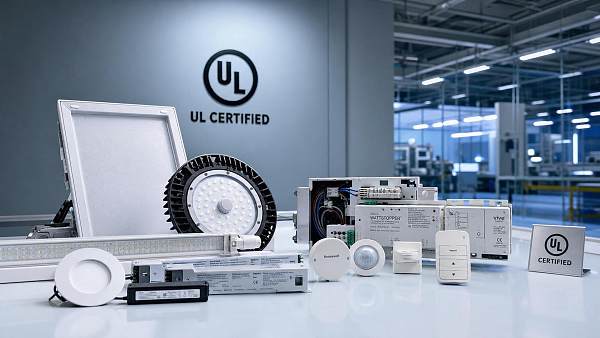
For many North American commercial and industrial installations, an appropriate third-party safety listing is a central purchasing requirement. UL and Intertek’s ETL are familiar certification marks. Both can indicate evaluation against applicable safety standards, provided the certification covers the product and intended jurisdiction.
Do not make the logo itself the deciding factor. Check the certification body, applicable standard, product category, model coverage, and acceptance requirements of the project or local authority. In the United States, the certification body’s recognition and scope under the Nationally Recognized Testing Laboratory program can matter. Canadian installations need evidence covering applicable Canadian requirements; a mark showing US coverage alone does not establish that.
The standard must also suit the product. Complete luminaires, LED drivers, replacement lamps, and retrofit kits have different evaluation requirements. A certificate for one category cannot automatically support another, even when the products share components.
A recognized component is not equivalent to a listed finished luminaire. A manufacturer may use a UL Recognized driver, but the assembled fixture still needs the appropriate evaluation. Wiring, insulation, grounding, enclosure construction, and operating temperatures all affect the safety of the final assembly.
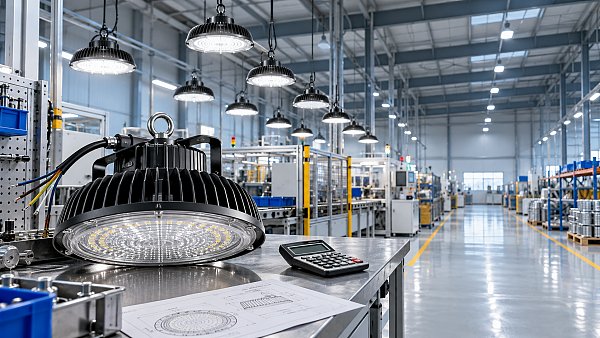
For an industrial high-bay purchase, request the certification record for the complete high-bay model and check its voltage, mounting arrangements, ambient-temperature rating, and suitability for the installation environment. The statement “we use certified drivers” leaves essential questions unanswered.
European Union: CE marking needs a supporting compliance file
CE marking is a manufacturer’s declaration that a product complies with applicable EU legislation. It is not, by itself, evidence that an independent certification body has approved the product. For many ordinary lighting products, compliance is established through the manufacturer’s conformity assessment and supporting technical documentation.
Request the EU declaration of conformity for the exact product or clearly identified product family. It should identify the responsible manufacturer, the product, applicable legislation, referenced standards where used, and the authorized signatory. Supporting reports should correspond to the design being supplied.
The applicable legislation depends on the equipment. Mains-powered lighting commonly involves electrical safety and electromagnetic compatibility requirements. RoHS addresses restrictions on specified hazardous substances in electrical and electronic equipment. Lighting with wireless connectivity can bring the Radio Equipment Directive into the assessment. Product-specific ecodesign and energy-labeling obligations may also apply.
RoHS compliance deserves its own review because it concerns materials and substances, rather than electrical safety. Evidence may include supplier declarations, material information, risk assessments, and testing where appropriate. A single laboratory report covering a few selected parts may provide limited assurance for a complete fixture assembled from numerous components.
A document labeled “CE certificate” should therefore prompt a closer look at its issuer, scope, and purpose. A laboratory assessment can support the compliance file, but it does not replace the manufacturer’s declaration or resolve every applicable obligation.
Other markets: establish the local route before ordering
Neither a North American safety listing nor CE marking provides universal market access. Other destinations may require local registration, designated certification bodies, particular labeling, or a locally responsible supplier. Requirements can also differ between product categories within the same country.
An IECEE CB Scheme test certificate and report can support applications for national certification where accepted. National differences and additional requirements may still apply. Treat these documents as useful evidence within an approval process, rather than as permission to sell everywhere.
For cross-border procurement, specify the destination and installation type in the initial request for quotation. Discovering a missing approval after production can force changes to components, labels, documentation, or the delivery schedule.
Use performance credentials to check the claims that affect the project
Once the market access route is established, examine the claims that influence operating cost and lighting quality. A compliant fixture may still deliver unsuitable light distribution, disappointing efficiency, or poor performance at the temperature where it will operate.
For certain commercial lighting purchases in North America, DesignLights Consortium qualification may matter because a utility incentive or project specification references the DLC Qualified Products List. Check the exact model against the relevant list and confirm the purchasing program’s own conditions. DLC qualification addresses defined performance criteria; it does not replace product safety certification or guarantee that every utility will offer an incentive.
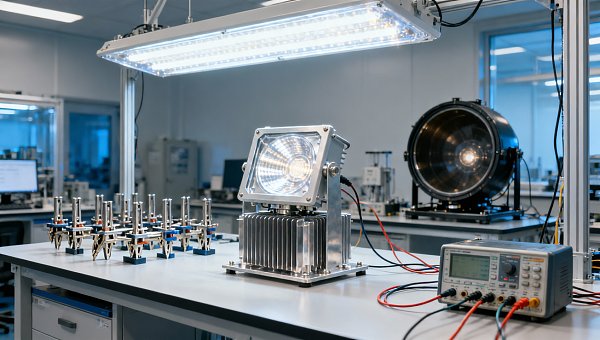
Laboratory reports require a different reading approach. IES LM-79 describes measurements of optical and electrical performance for solid-state lighting products. A relevant report can support claims about lumen output, electrical input, efficacy, and color characteristics under the reported test conditions. It is a test method, not a general manufacturer certification.
Check whether the tested configuration matches the quotation. Changes in drive current, optics, color temperature, or power supply can affect the result. A report for a lower-power version does not automatically substantiate the performance of every higher-power model in the same product family.
Lifetime claims need more care. LM-80 testing concerns lumen maintenance and color maintenance of LED packages, arrays, or modules. TM-21 provides a method for projecting lumen maintenance from suitable LM-80 data. These documents can support an assessment of the LED light source, but they do not establish the service life of every part of a finished luminaire.
Drivers, connections, seals, and thermal conditions can determine when a fixture becomes unusable. Ask how the supplier connects its lifetime claim to the selected LEDs, operating current, measured temperatures, and projection limits. An advertised lifetime should have a defined meaning and a traceable technical basis.
Application ratings also need supporting evidence. An IP rating addresses enclosure protection against access, solid objects, and water under specified test conditions. It does not establish resistance to salt corrosion, cleaning chemicals, ultraviolet exposure, or every outdoor environment. Hazardous locations and emergency lighting require evaluations appropriate to those applications; an ordinary luminaire listing cannot be stretched to cover them.
Check the manufacturer’s controls—and verify the paperwork
ISO 9001 is useful when assessing whether a manufacturer has a certified quality management system. Its value lies in processes such as document control, supplier management, corrective action, and handling nonconforming products. It does not guarantee that every shipment will meet the buyer’s specifications.
Read the certificate’s scope and site information. Certification covering trading activities or a head office provides different assurance from certification covering manufacture at the plant producing your order. Confirm the issuing certification body, validity, and relevant accreditation through appropriate verification channels.
ISO 14001 can be relevant when environmental management forms part of supplier qualification. It assesses an environmental management system, rather than certifying the environmental performance of a particular LED fixture. Neither
Recommended News
 Nov 16, 2026Can smart lighting solutions cut office energy costs in Southeast Asia?Explore smart lighting solutions Southeast Asia offices can use to reduce energy costs. Learn how to assess savings, compare controls and calculate payback.
 Nov 07, 2026How smart lighting improves operational efficiency in warehousesSmart lighting for operational efficiency can help warehouses reduce energy waste, support safer workflows and simplify maintenance. Explore practical implementation tips.
 Oct 19, 2026How to calculate payback on energy-saving lighting for factoriesCalculate payback on energy saving lighting for factories using verified costs, savings, and incentives. Explore a worked example and stress-test returns before investing.
 Nov 17, 2026Which Lighting Specifications Matter Most in Cleanrooms?Learn what lighting specs matter most for cleanroom environments, from illuminance and glare to sealing and flicker. Discover practical guidance for smarter fixture selection.
 Nov 16, 2026Which Certifications Should You Look for in LED Lighting Manufacturers?Wondering what certifications should I look for in LED lighting manufacturers? Explore UL, ETL, CE, RoHS and ISO 9001 checks to choose compliant suppliers with confidence.
 Oct 04, 2026When does smart lighting for retrofit projects deliver payback?Smart lighting for retrofit projects delivers payback through lower energy use, smarter controls, and reduced maintenance. Learn how to build a credible ROI case and choose the right system.
 Sep 25, 2026When does energy efficient lighting pay back its higher upfront cost?Energy efficient lighting payback explained: assess energy savings, maintenance, tariffs, incentives, controls, and ROI to build a confident investment case.
 Sep 22, 2026How energy saving lighting for offices can cut operating costsEnergy saving lighting for offices cuts operating costs through efficient LEDs, smart controls, realistic payback analysis, and lower maintenance needs. Explore practical upgrade strategies.
 Sep 04, 2026Are Energy-Efficient Lighting Rebates Available for Industrial Facilities?Are energy efficient lighting rebates available for industrial facilities? Explore eligibility, pre-approval, LED upgrades, controls, and cost-saving incentive tips.
 Aug 21, 2026Do LED lights with low power consumption really cut electricity costsLED lights low power consumption can lower electricity bills, but real savings depend on brightness, usage hours, and quality. Learn how to choose LEDs that cut costs and last longer.
 Jul 20, 2026How Much Does Energy Efficient Lighting Cost and When Does It Pay Off?Energy efficient lighting cost is more than fixture price. Learn what drives payback, hidden lifecycle costs, and when LED upgrades deliver the strongest return.
 Jul 19, 2026How to Choose LED Lights for Cold Storage: Temperature, IP Rating, and EfficiencyLED lights for cold storage: learn how to choose the right fixtures by comparing temperature tolerance, IP rating, visibility, and efficiency for safer, longer-lasting performance.
 Jul 10, 2026Lighting Cost Breakdown: Equipment, Installation, Energy Use, and MaintenanceLighting cost explained from equipment and installation to energy use and maintenance. Compare total ownership factors, avoid hidden expenses, and make smarter buying decisions.
 Jul 08, 2026Custom Lighting for Commercial Projects: How to Specify Output, Beam Angle, and ControlsLighting custom for commercial projects made practical: learn how to specify output, beam angle, and controls to improve performance, reduce risk, and make smarter buying decisions.
 Jul 06, 2026LED Lights Wholesale: How to Check MOQ, Warranty Terms, and Price BreaksLED lights wholesale made simple: learn how to verify MOQ, warranty terms, and price breaks to reduce sourcing risk, protect margins, and choose suppliers with confidence.
 Jul 06, 2026Intelligent Lighting for Factories: Which Control Features Improve Safety and Efficiency?Intelligent lighting for factories improves safety, cuts energy waste, and supports smoother workflows with motion sensing, zoning, daylight control, and emergency-ready features.
 Jul 04, 2026Smart Living for Smart Lighting: Which Controls and Sensors Fit Each Room?Smart living for smart lighting made simple: discover the best controls and sensors for every room to improve comfort, safety, and energy savings with smarter home planning.
 Jul 03, 2026UL Listed Lighting System Requirements: What to Check for Commercial ProjectsUL listed lighting system checks can make or break commercial approvals. Learn what to verify in listings, controls, ratings, and documents to avoid delays and compliance risk.
 Jul 02, 2026LED Lights Lumen Output Explained: How to Compare Brightness Across FixturesLED lights lumen output explained in a clear, practical guide. Learn how to compare fixture brightness, beam spread, efficiency, and color temperature before you buy.
 Jul 01, 2026Commercial LED Lighting in the Middle East: What to Check Before SpecificationCommercial LED lighting Middle East projects need more than price checks. Learn how to verify heat, dust, power, optics, compliance, and maintenance before specification.
 Jun 29, 2026Industrial Lighting Selection Guide: Beam Angle, IP Rating, and Energy Use by Facility TypeIndustrial lighting guide for smarter facility upgrades: compare beam angle, IP rating, and energy use by warehouse, manufacturing, washdown, and outdoor site needs.
 Jun 23, 2026UV Nail Lamps Explained: Wattage, Timer, and Gel Compatibility Before You BuyUVnaillamps explained: compare wattage, timer settings, and gel compatibility to avoid curing issues, choose the right lamp faster, and get smoother, longer-lasting gel manicure results.
 Jun 22, 2026Why LED Lights with Low Heat Emission Work Better for Display Cases and Tight SpacesLED lights low heat emission solutions help display cases and tight spaces stay cooler, safer, and more visually stable. Discover why they improve protection, performance, and long-term efficiency.
 Jun 21, 2026Lighting Technology Analysis for Commercial Spaces: Efficacy, CRI, and Control CompatibilityLighting technology analysis for commercial spaces: compare efficacy, CRI, and control compatibility to cut costs, improve visual quality, and choose smarter future-ready lighting systems.
{item.publish_time}{item.title}{item.description}